
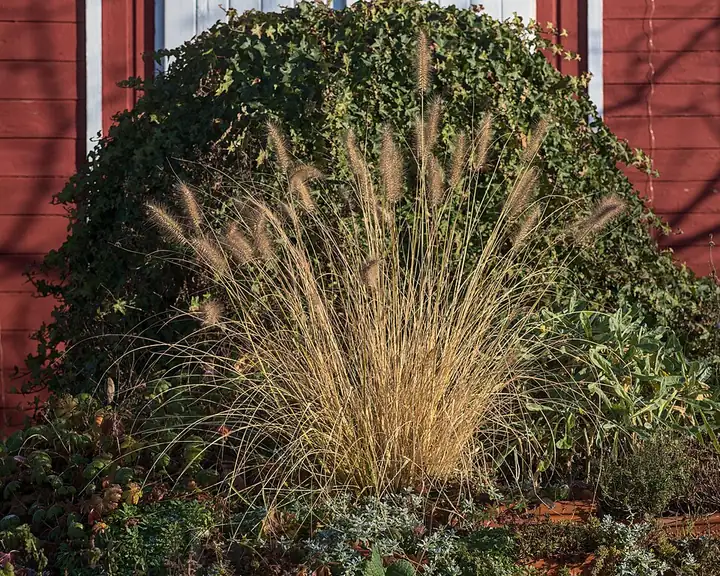
Fountain grass
Cenchrus alopecuroides (syn. Pennisetum alopecuroides); purple fountain grass is Cenchrus setaceus (syn. Pennisetum setaceum) · Grass family (Poaceae)
When to plant: Plant warm-season grasses like this in spring (Clemson).
| Hardiness zones | 6 to 9 |
|---|---|
| Sun | full sun |
| Water | moderate |
| Life cycle | perennial |
| Frost | Hardy: takes frost |
About Fountain grass
Fountain grass makes arching mounds with fuzzy, bottlebrush plumes from midsummer into fall (NC State). Hardy fountain grass is perennial; purple fountain grass ('Rubrum') is grown as an annual except in zones 9-10 (Clemson). Heads up: hardy fountain grass reseeds and has escaped into natural areas in some parts of the country, so choose sterile kinds like 'Cayenne', 'Etouffee', 'Hush Puppy' or 'Praline' (NC State, Clemson).
Hardy fountain grass is listed for zones 6-9 (NC State); purple fountain grass is hardy only in zones 9-10 (Clemson). Hardy fountain grass seeds itself and can invade natural areas; plant sterile cultivars.
When to plant
Plant warm-season grasses like this in spring (Clemson).
It flowers best in full sun. NC State notes the seed heads break open after a hard freeze, so cutting plumes off before then, or growing sterile kinds, limits seedlings.
Soil
Dry to moist, well-drained soil with organic matter (NC State).
Plant in well-drained soil with some organic matter (NC State).
Feeding
- Spring, only if a soil test shows a need: fertilizer only as a soil test recommends. Most ornamental grasses need very little fertilizer; base any feeding on a soil test (Clemson).
Too much nitrogen makes grasses weak, floppy and prone to disease (Clemson). Water thoroughly after planting and watch closely the first few weeks; established clumps want about 1 inch of water a week from rain or irrigation.
Varieties (12)
Sterile kinds are noted; NC State says 'Hameln', 'Little Bunny', 'Moudry', 'Red Head' and 'Viridescens' self-seed heavily.
| Variety | Type | Zones | Notes |
|---|---|---|---|
| Cayenne | Hardy fountain grass | 6–9typical for fountain grass | Dark red plumes. Sterile. Sources: [1] |
| Etouffee | Hardy fountain grass | 6–9typical for fountain grass | Soft pink plumes. Sterile. Sources: [1] |
| Hameln | Hardy fountain grass | 4–9 | Compact, about 2 ft; dark green leaves. Self-seeds aggressively. Sources: [1][2] |
| Hush Puppy | Hardy fountain grass | 6–9typical for fountain grass | 3-3.5 ft; long-lasting pink plumes. Sterile; doesn't self-seed. Sources: [1] |
| Little Bunny | Hardy fountain grass | 5–9 | Dwarf, 12-18 in. Self-seeds aggressively. Sources: [1][2] |
| Moudry | Hardy fountain grass | 5–9 | 2-3 ft; near-black plumes late summer to fall. Prolific self-seeder. Sources: [1][2] |
| Praline | Hardy fountain grass | 6–9typical for fountain grass | Compact; camel-colored plumes. Sterile. Sources: [1] |
| Red Head | Hardy fountain grass | 6–9typical for fountain grass | Soft red plumes. Self-seeds aggressively. Sources: [1] |
| Burgundy Giant | Purple fountain grass (annual) | 6–9typical for fountain grass | 5-6 ft; broad deep red leaves. Sources: [2] |
| Fireworks | Purple fountain grass (annual) | 6–9typical for fountain grass | 3-4 ft; leaves striped burgundy, hot pink, green and white. Sources: [2] |
| Rubrum | Purple fountain grass (annual) | 6–9typical for fountain grass | 3-5 ft; dark burgundy-red leaves and plumes; hardy only in zones 9-10. Sources: [2] |
| Rubrum Compacta | Purple fountain grass (annual) | 6–9typical for fountain grass | 2.5-3 ft; finer, less red leaves. Sources: [2] |
In the kitchen
Pets: Not listed as toxic by the ASPCA.
Sources
Photo: Photo: August Geyler / Wikimedia Commons, CC BY-SA 4.0 (CC BY-SA 4.0). Photo resized for the web.

Planting dates and advice are general guidance; check with your local Cooperative Extension office for your area.