
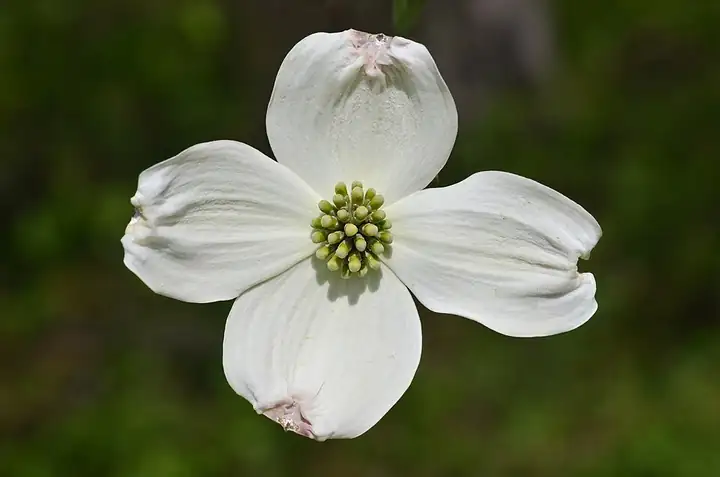
Flowering dogwood
Cornus florida · Dogwood family (Cornaceae)
When to plant: Container trees can go in any time the ground can be worked, but fall is the best season in the South because roots keep growing through mild weather (Clemson).
| Hardiness zones | 5 to 9 |
|---|---|
| Sun | full sun to part shade |
| Water | moderate |
| Life cycle | perennial |
| Frost | Hardy: takes frost |
About Flowering dogwood
Flowering dogwood is a native understory tree. Its white or pink 'flowers' are really four showy bracts around a button of tiny true flowers, opening in early spring before the leaves. Red fall leaves and glossy red berries follow, and songbirds, turkeys, squirrels and many other animals eat the fruit. NC State calls it tricky in hot, dry or city sites.
Zones 5-9 (NC State). In the Piedmont and on the coast it does best with afternoon shade.
When to plant
Container trees can go in any time the ground can be worked, but fall is the best season in the South because roots keep growing through mild weather (Clemson).
Plant container or balled-and-burlapped trees. Dig the hole no deeper than the root ball and at least twice as wide, keep the top roots level with the soil, and mulch 2-4 inches without touching the trunk. It does not tolerate air pollution well (NC State).
Soil
Well-drained soil high in organic matter, slightly acidic to neutral; a 2-4 inch mulch layer keeps the shallow roots cool and moist (NC State).
Test the soil first. Loosen a wide planting area and mix 10-20 percent compost into the native soil you dig out; don't use uncomposted bark, and don't dig deeper than the root ball (Clemson). Aim for slightly acidic to neutral soil high in organic matter (NC State).
Feeding
- Spring to early summer, after the tree is established, and only if a soil test or pale leaves and weak twig growth show a need: slow-release nitrogen fertilizer with a ratio near 3-1-1 or 3-1-2 (3-0-1 or 3-0-2 if the soil test shows enough phosphorus). Spread it evenly from just outside the trunk flare to the dripline and water it in. Clemson cites 2-4 lb of slow-release nitrogen per 1,000 sq ft per year, split into a spring and a late-summer feeding; follow your soil test.
Look for: mostly nitrogen, in spring as growth starts. Spring feeding grows the new shoots and leaves that carry flowers and fruit; feeding after midsummer pushes soft growth that may not harden before winter. - Late summer to early fall, the second half of the year's split feeding (only if a soil test calls for it): slow-release nitrogen fertilizer, same as spring. Apply the rest of the year's amount over the root zone and water in. Don't feed a drought-stressed tree in summer (Clemson).
Look for: mostly nitrogen, in spring as growth starts. Spring feeding grows the new shoots and leaves that carry flowers and fruit; feeding after midsummer pushes soft growth that may not harden before winter.
First-year watering matters far more than fertilizer: water daily for the first 1-2 weeks, every 2-3 days until week 12, then weekly, using about 1-1.5 gallons per inch of trunk diameter, until the tree is established, roughly 1.5 years per inch of trunk (UMN). Don't count on rain unless it was over an inch. Keep 2-4 inches of mulch over the shallow roots so they stay cool and moist in summer. It does not handle air pollution or hot, dry city sites well (NC State). Too much fertilizer can burn roots and push soft growth that pests and cold injure (Clemson).
Harvest
Blooms in early spring (March-May) before the leaves; no deadheading needed. Red berries ripen August-October; they are bitter and meant for birds, not people (NC State).
Varieties (14)
NC State documents these; disease resistance noted where the source gives it.
| Variety | Type | Zones | Notes |
|---|---|---|---|
| Pygmy | Dwarf | 5–9typical for flowering dogwood | Slow-growing dwarf with small flowers. Sources: [1] |
| Rubra | Pink | 5–9typical for flowering dogwood | Pink bracts; moderately resistant to spot anthracnose. Sources: [1] |
| Cherokee Brave | Red | 5–9typical for flowering dogwood | Red bracts with a pale center; reddish new leaves. Sources: [1] |
| Cherokee Chief | Red | 5–9typical for flowering dogwood | Red bracts; resists spot anthracnose. Sources: [1] |
| Sweetwater Red | Red | 5–9typical for flowering dogwood | Deep red bracts and reddish leaves. Sources: [1] |
| Cherokee Sunset | Red, variegated | 5–9typical for flowering dogwood | Variegated leaves and red bracts. Sources: [1] |
| Welchii | Variegated | 5–9typical for flowering dogwood | Green, creamy white and pink leaves; white bracts. Sources: [1] |
| Appalachian Spring | White | 5–9typical for flowering dogwood | White bracts; resists dogwood anthracnose but can get powdery mildew. Sources: [1] |
| Cherokee Princess | White | 5–9typical for flowering dogwood | Large white blooms; highly resistant to spot anthracnose. Sources: [1] |
| Cloud 9 | White | 5–9typical for flowering dogwood | Wide, overlapping white bracts. Sources: [1] |
| Appalachian Blush | White with pink edge | 5–9typical for flowering dogwood | Disease-resistant; white bracts edged in pink. Sources: [1] |
| Plena | White, double | 5–9typical for flowering dogwood | Semi-double white flowers, no fruit; immune to spot anthracnose. Sources: [1] |
| Cherokee Daybreak | White, variegated | 5–9typical for flowering dogwood | White bracts and variegated leaves; can get powdery mildew. Sources: [1] |
| Xanthocarpa | White, yellow fruit | 5–9typical for flowering dogwood | White bracts and yellow fruit. Sources: [1] |
Pests to watch for
Dogwood borer, Scale insects, Leafhoppers, Sawflies (garden sawflies)
Diseases and problems
Dogwood anthracnose, Spot anthracnose, Powdery mildew, Bacterial leaf scorch, Canker, Root rot, Leaf spot, Drought stress, Leaf scorch, Road salt injury, Girdling roots
In the kitchen
Safety: NC State describes the berries as bitter and not edible for people.
Pets: Not on the ASPCA's toxic plant list for dogs.
Sources
Photo: Photo: Derek Ramsey (Ram-Man) / Wikimedia Commons, CC BY-SA 4.0 (CC BY-SA 4.0). Photo resized for the web.

Planting dates and advice are general guidance; check with your local Cooperative Extension office for your area.