
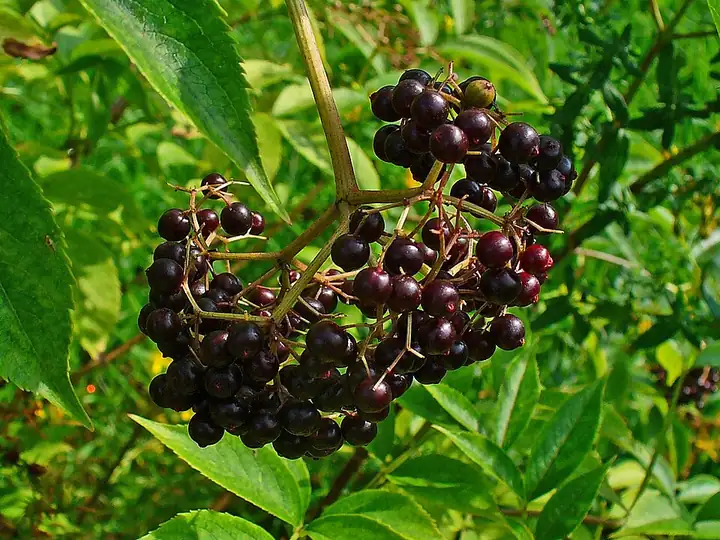
Elderberry (American)
Sambucus nigra subsp. canadensis (American elderberry) · Moschatel family (Adoxaceae)
| Hardiness zones | 4 to 8 |
|---|---|
| Sun | full sun to part shade |
| Water | moderate |
| Life cycle | perennial |
| Frost | Hardy: takes frost |
| Soil pH | 5.5–6.5 |
| Spacing | 48 to 84 inches |
About Elderberry (American)
American elderberry is a fast-growing native shrub with big flat clusters of white flowers and deep purple berries that birds love. The berries must be cooked before eating: raw berries, leaves and stems contain cyanide-forming compounds.
NC State lists zones 4-8; the native American elderberry is recommended over the European type for the Midwest (Ohio State; Penn State).
Planting
Expect a light crop in the second year and a full crop by the third or fourth year (Ohio State); Penn State suggests removing flowers the first year or two. Plants spread by root suckers.
Soil
Adaptable: tolerates wet to dry soils, though fruiting is best in sun (Penn State). Ohio State gives an ideal pH of 5.5-6.5, while Penn State cites 6.8-7.2.
Test the soil and aim for a pH of about 5.5-6.5; add organic matter, control perennial weeds, and plant on a raised berm if drainage is poor.
Feeding
- First year: 4-8 weeks after planting: nitrogen fertilizer such as 21-0-0. Give only a light feeding.
Look for: mostly nitrogen, in spring as growth starts. Spring feeding grows the new shoots and leaves that carry flowers and fruit; feeding after midsummer pushes soft growth that may not harden before winter. - Each spring from the second year on, as growth begins (late March-early April): nitrogen fertilizer such as 21-0-0, with phosphorus and potassium only if a soil test calls for them. Spread evenly around the plants; follow a soil test for the amount.
Look for: mostly nitrogen, in spring as growth starts. Spring feeding grows the new shoots and leaves that carry flowers and fruit; feeding after midsummer pushes soft growth that may not harden before winter.
Don't plant in low spots where spring frost settles.
Harvest
Berries are ripe when they turn deep purple, almost black (Ohio State). Flowers bloom in June-July in flat clusters up to 10 inches across (Penn State).
Elderberry flowers in June and gives one crop of berries in August (Wisconsin). Many growers cut all shoots to the ground each year so the next crop ripens more evenly.
Varieties (14)
University of Missouri trials found the northeastern Adams, York and Nova Scotia cultivars generally did not perform as well in Missouri as newer Midwest selections. European elderberry may be poorly adapted to the Midwest. All elderberries crop better with two or more cultivars.
| Variety | Type | Season and days | Zones | Notes |
|---|---|---|---|---|
| Adams 1 | American elderberry | August | 3–9 | Medium, sweet, juicy purple berries. Selected from the wild in New York (1926). Parent of Kent, Nova and Scotia. Wisconsin notes Adams 1 and 2 are now often sold together as 'Adams'. Sources: [3][7][8][9] |
| Adams 2 | American elderberry | August | 3–9 | Sweet, juicy purple berries. Among the most productive cultivars; a bit smaller-berried but more productive than Adams 1. Selected from the wild in New York (1926). Used as the ripening yardstick for other elderberries. Sources: [3][7][8][9] |
| Bob Gordon | American elderberry | About the same time as Adams 2 | 3–9 | Small to medium, sweet purple berries. Drooping clusters that birds find harder to raid. Large clusters on first-year shoots. Heavy crops. Selected near Osceola, Missouri; University of Missouri release (2011). Plant two or more cultivars; research suggests cross-pollination improves fruit set. Sources: [3][7][8][9] |
| Johns | American elderberry | Mid-August; several days before Adams | 3–9 | Firm, glossy, sweet purple-black berries. Released in Nova Scotia (1954). Did well in Ohio trials. Plant two or more cultivars; research suggests cross-pollination improves fruit set. Sources: [3][7][9] |
| Kent | American elderberry | 7-10 days before Adams 2 | 3–9typical for American elderberry | Medium to large berries. Seedling of Adams 1 from Nova Scotia (1957). Plant two or more cultivars; research suggests cross-pollination improves fruit set. Sources: [7][8][9] |
| Nova | American elderberry | Early August; earlier than Adams 2 | 4–8 | Large, soft, sweet purple-black berries, sweeter than Kent or Victoria. Seedling of Adams 2, released in Nova Scotia (1959). Plant two or more cultivars; research suggests cross-pollination improves fruit set. Sources: [3][7][9] |
| Pocahontas | American elderberry | A few days after Bob Gordon; ripens evenly | 3–9typical for American elderberry | Medium, dark purple berries. Very vigorous and upright, to about 6 ft, with very large clusters. Out-yielded Bob Gordon in Missouri trials. Wild selection from Pocahontas, Arkansas; shared with growers from 2019. Plant two or more cultivars; research suggests cross-pollination improves fruit set. Sources: [8][9][10] |
| Ranch | American elderberry | August | 3–9typical for American elderberry | Small, glossy black, sweet berries. Found at an old homestead. Does well in poor soils; very drought-tolerant with high pest and disease tolerance. Part of the University of Missouri elderberry program. Sources: [8][9] |
| Scotia | American elderberry | 3–9typical for American elderberry | Medium to large berries, sweeter than Kent or Victoria. Seedling of Adams 2, released in Nova Scotia (1959). Plant two or more cultivars; research suggests cross-pollination improves fruit set. Sources: [3][7][9] | |
| Victoria | American elderberry | 3-6 days before Adams 2 | 3–9typical for American elderberry | Medium to large berries. Released in Nova Scotia (1957). Plant two or more cultivars; research suggests cross-pollination improves fruit set. Sources: [7][8][9] |
| Wyldewood | American elderberry | 7-10 days after Adams 2 | 3–9 | Small to medium, dark purple to black berries for jam, jelly and wine. Large, vigorous, upright shrub with huge flower clusters, up to a foot across. Very productive in the Midwest. Selected from the wild near Eufaula, Oklahoma; University of Missouri release (2010). West Virginia University names Ranch and Bob Gordon as good pollinators for it. Sources: [3][7][8][9] |
| York | American elderberry | Mid- to late August; earlier than Adams 2 in Missouri | 4–8 | Soft, sweet, juicy, very dark berries; deeply pigmented. The largest berries of the American cultivars. Bred in New York from Adams 2 x Ezyoff (1964). Plant two or more cultivars; research suggests cross-pollination improves fruit set. Sources: [3][7][9] |
| Korsor | European elderberry | August to September | 5–7typical for European elderberry | Large, glossy, sweet, juicy black berries. Danish selection; very winter-hardy, with high pigment content. Partly self-fruitful. Range is for European elderberry (Sambucus nigra) as a species. Sources: [9][11] |
| Samyl | European elderberry | 5–7typical for European elderberry | Used mainly for juice, plus pies, wine and jam. Danish selection with very high pigment (anthocyanin) content. Missouri trials suggest European elderberry may not be well adapted to the Midwest. Range is for European elderberry (Sambucus nigra) as a species. Sources: [7][9][11] |
Pests to watch for
Japanese beetle, Spotted wing drosophila, Birds, Twospotted spider mite, Aphids
Diseases and problems
In the kitchen
Cooked berries go into pies, jams, syrups and fruit leather; the flowers flavor syrups, sorbets and drinks (Penn State).
Keeping it: Strip berries from stems and freeze them soon after picking; cook them later. Cooked syrups and jams keep a few weeks in the fridge.
Safety: Raw or unripe berries, leaves and stems contain cyanide-producing compounds (sambunigrin) that can cause nausea, vomiting and severe diarrhea; cooking the berries destroys the toxin, and large amounts of the toxin can cause serious illness (NCCIH; Penn State). Do not confuse it with red elderberry (Sambucus racemosa), whose red berries are poisonous (Penn State). Little is known about safety in pregnancy (NCCIH).
Pets: Toxic to dogs, cats and horses (ASPCA): the leaves, stems, roots and unripe berries hold cyanide-forming compounds
Sources
- extension.psu.edu
- plants.ces.ncsu.edu
- ohioline.osu.edu
- nccih.nih.gov
- aspca.org
- aspca.org
- extension.missouri.edu
- cropsandsoils.extension.wisc.edu
- extension.wvu.edu
- ishs.org
- plants.ces.ncsu.edu
Photo: Photo: H. Zell, CC BY-SA 3.0, via Wikimedia Commons (CC BY-SA 3.0). Photo resized for the web.

Planting dates and advice are general guidance; check with your local Cooperative Extension office for your area.