
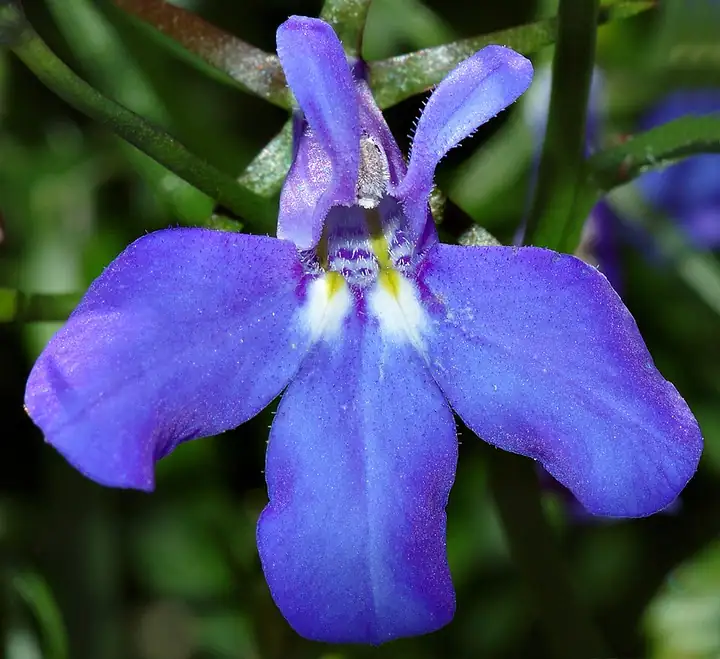
Edging lobelia
Lobelia erinus · Bellflower family (Campanulaceae)
When to plant: Start seeds indoors 8 to 13 weeks before the last frost and set out plants up to 2 weeks after the last frost.
| Hardiness zones | 10 to 11 |
|---|---|
| Sun | full sun to part shade |
| Water | high |
| Life cycle | tender perennial (grown as an annual) |
| Frost | Tender: killed by frost |
| Spacing | 6 to 12 inches |
| Days to harvest | 120 days |
About Edging lobelia
Edging lobelia is a small, mounding or trailing annual covered in tiny flowers, most often in deep blue or violet, often with a white eye. It came from South Africa's Cape and was the favorite blue of Victorian bedding schemes; today it's loved in window boxes, hanging baskets and along bed edges. It likes cool weather and steady moisture, often resting in summer heat and blooming again in fall. It's a cousin of the native cardinal flower, which has its own entry.
Perennial only in zones 10-11 (NC State); everywhere else it's a spring-to-fall annual, best in cool-summer areas. In Florida it's grown in the cool season (UF/IFAS).
When to plant
Timing is counted from your average last spring frost (and first fall frost). Sow & Tell works out the actual dates for your ZIP code.
- Start seeds indoors: 8 to 13 weeks before the last frost
- Set out plants: up to 2 weeks after the last frost
Days to harvest count from sowing: UF/IFAS says plants bloom about four months after seeding. Start seed indoors about 8 weeks before planting out (Arkansas); UMN allows 12-13 weeks indoors. NC State notes it can be tricky from seed, so most gardeners buy plants. Set out after the last frost, since it won't take a late spring freeze (Arkansas); in Florida plant in fall or winter (UF/IFAS).
Soil
Rich, well-drained soil kept evenly moist; it has little drought tolerance but rots if waterlogged, especially in southern heat (NC State, Arkansas, UF/IFAS).
Plant in rich, fertile, well-drained soil with plenty of organic matter (NC State, UF/IFAS).
Feeding
- Every two weeks through the growing season: balanced fertilizer. NC State suggests feeding about every two weeks; Illinois says keep feeding in summer to keep it flowering. Follow the label rate.
Look for: a balanced or all-purpose fertilizer at the label rate. Skip high-phosphorus "bloom boosters" unless a soil test shows low phosphorus: most garden soils already have enough, and the extra can wash into streams.
Don't overwater: soggy soil in summer heat often rots the roots, especially in the South (Arkansas, NC State).
Harvest
Blooms from late spring into summer and again as fall cools (June to October in Illinois). It often stops flowering in hot weather; shear plants back after each flush to bring on more blooms (NC State, Illinois, UF/IFAS).
Varieties (13)
NC State and UF/IFAS document 13 cultivars and series; few sizes are given.
| Variety | Type | Notes |
|---|---|---|
| Blue Moon | Mounding | Dark blue flowers. Sources: [1][3] |
| Cambridge Blue | Mounding | Compact, 4-6 in, with soft blue flowers. Sources: [1][3] |
| Compacta | Mounding | Listed by NC State. Sources: [1] |
| Crystal Palace | Mounding | Bronze-green leaves and dark blue flowers. Sources: [1][3] |
| Paper Moon | Mounding | White flowers. Sources: [1][3] |
| Rosamunde | Mounding | Carmine-red flowers with a white eye. Sources: [1][3] |
| Snowball | Mounding | White flowers. Sources: [1][3] |
| White Lady | Mounding | White flowers. Sources: [1][3] |
| Blue Cascade | Trailing | Listed by UF/IFAS. Sources: [3] |
| Fountain series | Trailing | Listed by UF/IFAS. Sources: [3] |
| Hamburgia | Trailing | Listed by NC State and UF/IFAS. Sources: [1][3] |
| Sapphire | Trailing | Purple flowers with a white eye. UF/IFAS calls it one of the best trailing lobelias. Sources: [1][3] |
| Laguna Heavenly Lilac | Listed by NC State. Sources: [1] |
Diseases and problems
Damping-off, Stem rot, Root rot
In the kitchen
Safety: Poisonous to people (NC State, medium severity): all parts contain lobeline and related alkaloids, and eating large amounts can cause nausea, vomiting, diarrhea, weakness and worse. Colorado State lists Lobelia species among toxic garden plants. Don't eat any part.
Pets: Toxic to dogs, cats and horses (ASPCA): its lobelia entry (cardinal flower, L. cardinalis) lists lobeline, with vomiting, diarrhea, drooling, depression, belly pain and heart rhythm problems. The ASPCA has no separate entry for edging lobelia, but NC State notes it contains the same alkaloids.
Sources
- plants.ces.ncsu.edu
- uaex.uada.edu
- ask.ifas.ufl.edu
- extension.illinois.edu
- extension.umn.edu
- aspca.org
- extension.colostate.edu
Photo: Photo: André Karwath / Wikimedia Commons, CC BY-SA 2.5 (CC BY-SA 2.5). Photo resized for the web.

Planting dates and advice are general guidance; check with your local Cooperative Extension office for your area.