
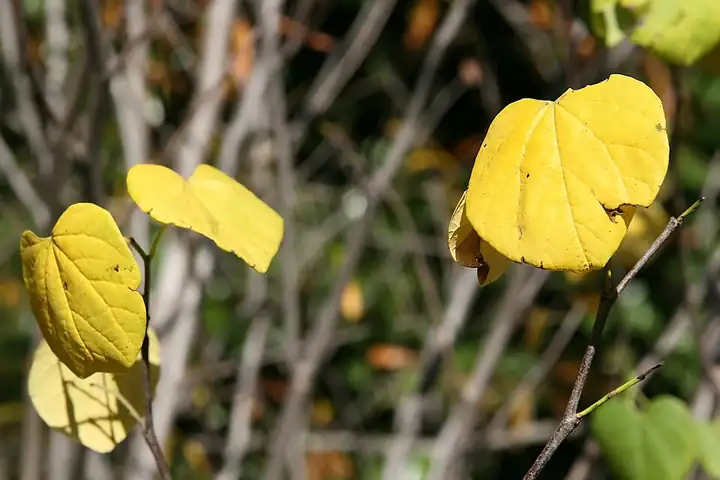
Eastern redbud
Cercis canadensis · Pea family (Fabaceae)
When to plant: Container trees can go in any time the ground can be worked, but fall is the best season in the South because roots keep growing through mild weather (Clemson).
| Hardiness zones | 4 to 9 |
|---|---|
| Sun | full sun to part shade |
| Water | moderate |
| Life cycle | perennial |
| Frost | Hardy: takes frost |
About Eastern redbud
Eastern redbud is a small native tree whose bare branches are covered with rosy-pink to lavender flowers in early spring, before its heart-shaped leaves open. Bees and butterflies use it, and it fits well at a woodland edge or as a specimen. It is often short-lived: Clemson notes many decline from canker after about 20 years.
Zones 4b-9a (UF/IFAS). Buy trees grown from local seed; Clemson notes trees from northern seed may not handle Southern summer heat.
When to plant
Container trees can go in any time the ground can be worked, but fall is the best season in the South because roots keep growing through mild weather (Clemson).
Plant container or balled-and-burlapped trees. Dig the hole no deeper than the root ball and at least twice as wide, keep the top roots level with the soil, and mulch 2-4 inches without touching the trunk. Plant a young tree in its permanent spot, because redbuds resent root disturbance (NC State, Clemson). It is very sensitive to lawn weed killers sprayed nearby (NC State).
Soil
Clay, sand or loam, acidic or alkaline; prefers moist, well-drained soil and won't tolerate soil that stays wet (Clemson, UF/IFAS).
Test the soil first. Loosen a wide planting area and mix 10-20 percent compost into the native soil you dig out; don't use uncomposted bark, and don't dig deeper than the root ball (Clemson).
Feeding
- Spring, once established: slow-release tree and shrub fertilizer. Clemson's redbud sheet suggests spring feedings about every six weeks with a slow-release product; follow a soil test and the label.
Look for: mostly nitrogen, in spring as growth starts. Spring feeding grows the new shoots and leaves that carry flowers and fruit; feeding after midsummer pushes soft growth that may not harden before winter.
First-year watering matters far more than fertilizer: water daily for the first 1-2 weeks, every 2-3 days until week 12, then weekly, using about 1-1.5 gallons per inch of trunk diameter, until the tree is established, roughly 1.5 years per inch of trunk (UMN). Don't count on rain unless it was over an inch. Clemson suggests watering established redbuds deeply once a week in dry spells and mulching out to the dripline. Avoid wounding the trunk with mowers and don't spray lawn weed killers nearby; wounds let in canker and the tree is herbicide-sensitive. Too much fertilizer can burn roots and push soft growth that pests and cold injure (Clemson).
Harvest
Blooms for 2-3 weeks in early spring, before the leaves; no deadheading needed. Prune only in dry weather, cutting 6-8 inches below any sunken, cankered area and wiping pruners with rubbing alcohol between cuts (Clemson).
Varieties (18)
| Variety | Type | Zones | Notes |
|---|---|---|---|
| Ace of Hearts | Compact | 4–9typical for eastern redbud | About 12 ft tall; flowers much pinker than the species. Sources: [1][2] |
| Pink Pom Poms | Double-flowered | 4–9typical for eastern redbud | Double dark pink-purple flowers; sterile, no seed pods. Sources: [1][2] |
| Appalachian Red | Flower color | 4–9typical for eastern redbud | 15-20 ft; fuchsia-pink to red flowers, heavy bloom, later than most. Sources: [1][2] |
| Hearts of Gold | Gold-leaf | 4–9typical for eastern redbud | About 15 ft; golden spring leaves turning chartreuse; reddish-purple flowers; rarely sets pods. Found in Greensboro, NC. Sources: [1][2] |
| The Rising Sun ('JN2') | Gold/orange-leaf | 4–9typical for eastern redbud | 8-12 ft tall; apricot new leaves maturing to green; pinkish-purple flowers. Sources: [1][2] |
| Forest Pansy | Purple-leaf | 4–9typical for eastern redbud | Burgundy leaves fading to bronze in summer; rose-purple flowers. Susceptible to verticillium wilt. Sources: [1][2] |
| Merlot | Purple-leaf | 4–9typical for eastern redbud | 12-15 ft, semi-upright; wine-red, heat-tolerant leaves; a cross of 'Forest Pansy' and 'Texas White'. Sources: [1][2] |
| Oklahoma | Texas redbud (var. texensis) | 6+ | 15-20 ft; glossy, thick leaves; lavender-pink flowers. Sources: [2] |
| Texas White | Texas redbud (var. texensis) | 6+ | 15-20 ft; glossy, thick leaves; white flowers. Sources: [2] |
| Alley Cat | Variegated | 4–9typical for eastern redbud | About 20 ft; white-variegated leaves that resist scorch. Sources: [2] |
| Carolina Sweetheart ('NCCC1') | Variegated | 4–9typical for eastern redbud | 20-30 ft tall; new leaves maroon, then white, green and hot pink. Sources: [1][2] |
| Lavender Twist ('Covey') | Weeping | 4–9typical for eastern redbud | 5-6 ft tall, 6-8 ft wide umbrella shape; golden-yellow fall color. Sources: [1][2] |
| Pink Heartbreaker | Weeping | 4–9typical for eastern redbud | 8-10 ft tall; lots of lavender-pink flowers and few pods. Sources: [2] |
| Ruby Falls | Weeping, purple-leaf | 4–9typical for eastern redbud | 6-8 ft tall; purple leaves turning bronzy green by midsummer. Sources: [1][2] |
| Whitewater ('NC2007-8') | Weeping, variegated | 4–9typical for eastern redbud | About 8 ft tall; white-and-green leaves; deep rose-purple flowers. Sources: [1][2] |
| Vanilla Twist | Weeping, white-flowered | 4–9typical for eastern redbud | About 12 ft tall, 8 ft wide; white flowers. Sources: [1][2] |
| Alba (white redbud) | White-flowered | 4–9typical for eastern redbud | 15-25 ft; white flowers and lighter green leaves. Sources: [1][2] |
| Royal White | White-flowered | 4–9typical for eastern redbud | Bigger, more plentiful white flowers on a more compact tree than 'Alba'. Sources: [2] |
Pests to watch for
Leafhoppers, Scale insects, Granulate ambrosia beetle, Japanese beetle
Diseases and problems
Canker, Verticillium wilt, Leaf spot, Overwatering and waterlogged soil
In the kitchen
Pets: Not on the ASPCA's toxic plant list for dogs.
Sources
- plants.ces.ncsu.edu
- hgic.clemson.edu
- ask.ifas.ufl.edu
- extension.rutgers.edu
- aspca.org
- hgic.clemson.edu
- hgic.clemson.edu
- extension.umn.edu
Photo: Photo: David J. Stang / Wikimedia Commons, CC BY-SA 4.0 (CC BY-SA 4.0). Photo resized for the web.

Planting dates and advice are general guidance; check with your local Cooperative Extension office for your area.