
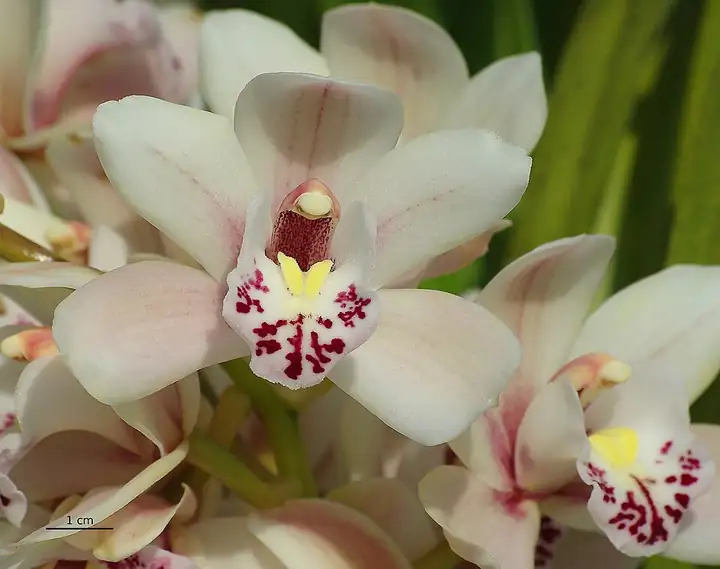
Cymbidium orchid
Cymbidium spp. and hybrids (boat orchid) · Orchid family (Orchidaceae)
When to plant: Any time of year, since it grows indoors. Repot about every two years, when the mix breaks down, and divide big clumps then.
| Hardiness zones | 10 to 12 |
|---|---|
| Sun | part shade |
| Water | moderate |
| Life cycle | perennial |
| Frost | Tender: killed by frost |
Will it grow in your window?
Pick the window it sits in. This is the same check Sow & Tell runs for every plant in your house.
It wants bright, indirect light.
Pick a window above and this will tell you whether the spot suits it.
Watering: keep it evenly moist — about every 4 days, stretching to every 7 from November to February.
Summering outside? Bring it in before nights drop below 50°F.
About Cymbidium orchid
Cymbidiums are big, grassy-leaved orchids from Asia and Australia that carry tall spikes of 6-12 waxy, often fragrant flowers lasting one to three months, the classic corsage orchid (NC State). The large standard types need summer days of 75-85 F with nights of 50-60 F and a big day-to-night swing to set flower spikes, which is why they do best summered outdoors; miniature types take more heat. They need more light than moth orchids and plenty of water while growing.
Hardy outdoors only in zones 10-12 (NC State); it is grown indoors everywhere and is best summered outdoors in bright light once nights stay above about 50 F, where cool late-summer nights help it set buds (NC State, MU Extension).
When to plant
Any time of year, since it grows indoors. Repot about every two years, when the mix breaks down, and divide big clumps then.
Usually bought as a blooming nursery plant or divided from an older clump (NC State, UF/IFAS).
Growing it indoors
- Light: Bright light with a few hours of gentle direct sun, especially while it is growing, is what makes it bloom; harsh direct sun scorches the leaves (NC State; MU Extension says filtered to bright).
- Water: Water heavily with lukewarm water while it is growing so the mix stays moist but drains freely, and water less from fall (NC State, MU Extension). Never let it stand in water; soggy mix rots the roots.
- Humidity: NC State aims for 40-60 percent humidity; a pebble tray helps indoors in winter (Wisconsin Horticulture).
- Temperature: Standard types want 50-60 F nights and a big day-night swing to bloom; miniatures take 5-10 degrees more heat (NC State), and MU Extension gives 55 F nights, so a cool room suits it far better than a warm one.
- Feeding: Feed every 1-2 weeks during the growing season with a high-nitrogen orchid fertilizer (NC State); UF/IFAS warns too much fertilizer can stop it blooming and says to wait several weeks after repotting.
- Repotting: Repot when the mix breaks down or the plant outgrows its pot, about every two years, removing dead roots and dividing big clumps (UF/IFAS, Wisconsin Horticulture).
- More plants: Divide large clumps when you repot (NC State, UF/IFAS).
If something looks wrong
| What you see | Likely cause | What to do |
|---|---|---|
| Healthy leaves but no flower spikes | Nights too warm, too little light, or too much fertilizer | Summer it outdoors in bright light where nights fall to 50-60 F, and don't overfeed (NC State, UF/IFAS). |
| Brown spots or streaks on the leaves | Cymbidium mosaic virus, or uneven watering | Water steadily; if the spots keep spreading on new leaves, suspect the virus and keep that plant apart from your other orchids (NC State names cymbidium mosaic virus). |
| Yellowing leaves and mushy roots | Root rot from soggy mix | Repot into fresh orchid mix, trimming dead roots, and let it drain fully (NC State, UF/IFAS). |
| Scorched, bleached patches on the leaves | Too much direct sun | Give it light shade at midday (NC State). |
Soil
A commercial orchid mix labeled for cymbidiums, acid and well drained (NC State).
Pot in a commercial orchid mix labeled for cymbidiums, acid and free-draining (NC State).
Feeding
- Spring and summer, during the growing season: high-nitrogen orchid fertilizer. Every 1-2 weeks (NC State); wait several weeks after repotting before feeding (UF/IFAS).
- Fall and winter, while spikes form and bloom: less or none. Water less from fall (NC State); UF/IFAS warns too much fertilizer can stop orchids blooming.
Overfeeding and soggy mix are common mistakes; too much fertilizer can stop blooming and wet roots rot (UF/IFAS, NC State).
Harvest
Standard types bloom in winter and early spring, after a summer and fall of 50-60 F nights and a day-to-night swing of up to 25 degrees; miniature types bloom in summer (NC State). The spikes last 1-3 months and make good cut flowers; cut the spent spike at its base (Wisconsin Horticulture).
Varieties (10)
NC State Extension names 9 species and 1 hybrid cultivar; most cymbidiums sold are unnamed hybrids.
| Variety | Type | Zones | Notes |
|---|---|---|---|
| Magic Chocolate | Hybrid | 10+typical for cymbidium orchid | 2-3 ft, with green flowers striped brown and a brown-spotted white lip. Sources: [1] |
| Cymbidium aloifolium (aloe-leafed) | Species | 10+typical for cymbidium orchid | 1-2 ft with waxy strap leaves and many greenish-yellow to reddish-brown flowers. Sources: [1] |
| Cymbidium dayanum | Species | 10+typical for cymbidium orchid | About 1 ft, with pink and red summer flowers. Sources: [1] |
| Cymbidium erythrostylum (red column) | Species | 10+typical for cymbidium orchid | White flowers with red center markings on 6-14 in stalks. From Vietnam. Sources: [1] |
| Cymbidium kanran | Species | 10+typical for cymbidium orchid | Winter-blooming, with narrow-petaled green, yellow and brown flowers and a musky scent. Sources: [1] |
| Cymbidium sinense (Chinese) | Species | 10+typical for cymbidium orchid | Up to 3 ft, with 10-20 fragrant, star-shaped, dark maroon to purplish-brown flowers. Sources: [1] |
| Cymbidium ensifolium (sword-leaf) | Species, miniature | 10+typical for cymbidium orchid | 8-16 in with pale green leaves and 3 in yellow or green flowers marked red or brown. Sources: [1] |
| Cymbidium floribundum (gold margin) | Species, miniature | 10+typical for cymbidium orchid | 6-10 in, with spring flowers 1-1.5 in across, reddish-brown or greenish-yellow with a red-spotted white lip. Sources: [1] |
| Cymbidium goeringii (noble orchid) | Species, miniature | 10+typical for cymbidium orchid | About 4 in with grassy leaves and fragrant green-and-white flowers. Sources: [1] |
| Cymbidium tracyanum (Tracy's) | Species, standard | 10+typical for cymbidium orchid | 3-4 ft, with 10-20 olive to dark green flowers and a red-spotted cream lip in fall and winter. Sources: [1] |
Pests to watch for
Aphids, Twospotted spider mite, Scale insects, Mealybugs, Thrips
Diseases and problems
Root and crown rot, Mosaic viruses, Fungal leaf spots, Orchid viruses
In the kitchen
Safety: Not listed as poisonous in the sources we opened (NC State gives no toxicity, and the ASPCA has no cymbidium entry).
Pets: Not listed by the ASPCA (no Cymbidium entry on its plant lists).
Sources
- plants.ces.ncsu.edu
- extension.missouri.edu
- gardeningsolutions.ifas.ufl.edu
- hort.extension.wisc.edu
- aspca.org
- aspca.org
Photo: Photo: JLPC, CC BY-SA 3.0, via Wikimedia Commons (CC BY-SA 3.0). Photo resized for the web.

Planting dates and advice are general guidance; check with your local Cooperative Extension office for your area.