
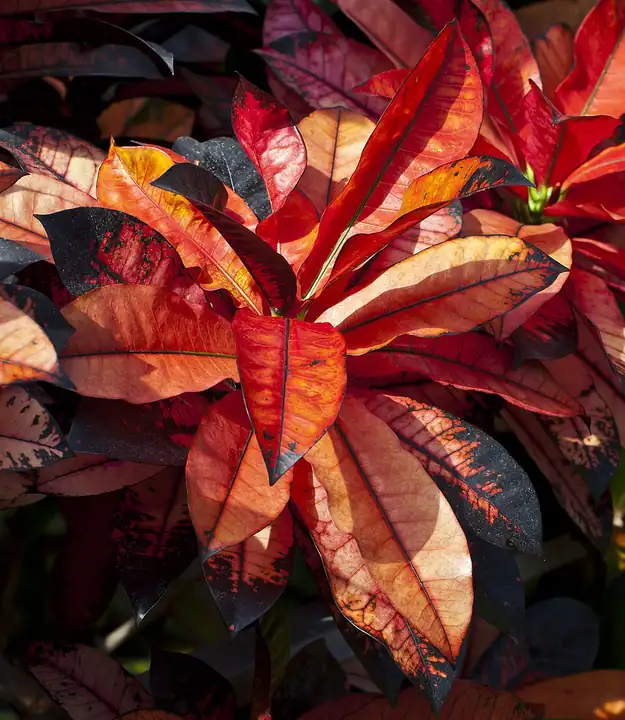
Croton
Codiaeum variegatum (formerly C. variegatum var. pictum) · Spurge family (Euphorbiaceae)
When to plant: Any time of year, since it grows indoors. Repot when roots outgrow the pot, going up only 1-2 inches; stem cuttings root in under a month in warm mix.
| Hardiness zones | 11 to 12 |
|---|---|
| Sun | full sun to part shade |
| Water | moderate |
| Life cycle | perennial |
| Frost | Tender: killed by frost |
Will it grow in your window?
Pick the window it sits in. This is the same check Sow & Tell runs for every plant in your house.
It wants bright, direct light.
Pick a window above and this will tell you whether the spot suits it.
Watering: water when the top inch is dry — about every 7 days, stretching to every 12 from November to February.
Summering outside? Bring it in before nights drop below 50°F.
About Croton
Croton is a tropical shrub from Malaysia, the Pacific islands and northern Australia grown for leathery leaves splashed and veined in yellow, orange, red, pink, purple and green; hundreds of cultivars range from broad ovals to twisted ribbons (NC State, Wisconsin Horticulture). In a pot it usually stays around 3 ft tall and needs more light than most houseplants to keep its color. It is also touchy: a cold draft, a move, or soil that stays too wet or too dry makes it drop leaves, and the milky sap irritates skin and stains fabric for good.
Hardy outdoors only in zones 11-12 (NC State); it is grown indoors everywhere and can summer outdoors in part shade once nights stay reliably above 50 F, coming back in before fall temperatures drop below 50 F (Wisconsin Horticulture, NC State).
When to plant
Any time of year, since it grows indoors. Repot when roots outgrow the pot, going up only 1-2 inches; stem cuttings root in under a month in warm mix.
Usually bought as a nursery plant or started from a 3-4 in stem cutting rooted in warm, moist mix; cultivars don't come true from seed (UF/IFAS, Wisconsin Horticulture).
Growing it indoors
- Light: It needs bright light with some direct sun to keep its color; in too little light the new leaves come in plain green, and in harsh all-day sun they fade gray and dull (NC State, Wisconsin Horticulture, UF/IFAS).
- Water: Water only when the top half inch to inch of mix is dry, soaking it through, and water sparingly in winter (Wisconsin Horticulture, NC State); MU Extension's table says keep it evenly moist. Wilting new leaves mean it is thirsty, but mix that stays wet or dry for long stretches makes it drop leaves (UF/IFAS, Wisconsin Horticulture).
- Humidity: It likes moderate to high humidity; set the pot on a tray of wet pebbles in dry rooms (NC State, Wisconsin Horticulture).
- Temperature: Keep it at 60-85 F and away from drafts and sudden temperature swings, which shock it into dropping leaves; below 50 F leaves fall (Wisconsin Horticulture, NC State).
- Feeding: Wisconsin Horticulture feeds only once or twice during the growing season, more often for faster growth; MU Extension's general rule is about once a month while new leaves are coming and none in winter.
- Repotting: Repot when the roots outgrow the pot, moving up only 1-2 in in diameter into fresh well-drained mix (Wisconsin Horticulture).
- More plants: Softwood stem cuttings 3-4 in long with 3-5 leaves, dipped in rooting hormone and kept moist and warm at 70-80 F, root in under a month; air layer a leggy plant in spring (UF/IFAS, Wisconsin Horticulture). Prune hard in early spring to force branching.
If something looks wrong
| What you see | Likely cause | What to do |
|---|---|---|
| Leaves dropping after a move or a cold night | Drafts, a sudden temperature change, or mix kept too wet or too dry | Keep it above 50 F away from doors and vents, and water only when the top inch is dry (Wisconsin Horticulture). |
| New leaves coming in green, colors fading | Too little light | Move it to a window with some direct sun; 'Petra' holds its color best indoors (UF/IFAS, Wisconsin Horticulture). |
| Leaves gray, dull and bleached | Too much harsh direct sun | Pull it back from the glass or filter the afternoon sun (Wisconsin Horticulture, UF/IFAS). |
| Stippled, dusty-looking leaves with fine webs underneath | Spider mites, its main pest | Shower the leaves, spray the undersides with insecticidal soap and raise the humidity; repeat weekly until clean (NC State, UF/IFAS). |
Soil
A fertile, humus-rich, well-drained potting mix in a pot with a drainage hole (NC State, Wisconsin Horticulture).
Pot in a fertile, humus-rich, well-drained potting mix in a container with a drainage hole (NC State, Wisconsin Horticulture).
Feeding
- Spring through summer, while new leaves are coming: balanced water-soluble houseplant fertilizer. Wisconsin Horticulture feeds once or twice a season, more often for faster growth; MU Extension's general rule is about once a month, watering first and never feeding a wilted plant.
- Winter: none. Skip feeding and water sparingly while light is low (NC State, MU Extension).
Don't repot or feed a plant that is dropping leaves; fix the drafts, light and watering first (Wisconsin Horticulture).
Varieties (15)
| Variety | Type | Zones | Notes |
|---|---|---|---|
| Andreanum | Broad oval leaf | 11+typical for croton | Broad oval yellow leaves with gold veins and edges. Sources: [1][2] |
| Evening Embers | Broad oval leaf | 11+typical for croton | Metallic blue-black leaves with red and green highlights. Sources: [1][2] |
| Gold Dust | Broad oval leaf | 11+typical for croton | Rounded bright green leaves speckled with golden-yellow spots. Sources: [1][2] |
| Magnificent | Broad oval leaf | 11+typical for croton | Green and yellow leaves spattered with red, orange, pink and sometimes bronze or purple. Sources: [2] |
| Mrs. Iceton | Broad oval leaf | 11+typical for croton | Pointed oval leaves that open bright yellow and turn pink and red. Also sold as 'Red Iceton'. Sources: [2] |
| Petra | Broad oval leaf | 11+typical for croton | The most common croton: dark green oval leaves veined yellow, pink, orange and red; holds its color in indoor light better than most. Sources: [1][2][3] |
| Oakleaf | Lobed leaf | 11+typical for croton | Oak-shaped lobed leaves in green to bronze with red, orange or yellow veins. Sources: [2] |
| Eleanor Roosevelt | Narrow leaf | 11+typical for croton | Long slender green leaves with yellow spots that darken to red with age. Sources: [1][2] |
| Franklin Roosevelt | Narrow leaf | 11+typical for croton | Like 'Eleanor Roosevelt' with yellow, orange and pink splashes. Sources: [1][2] |
| Gold Star | Narrow leaf | 11+typical for croton | Like 'Gold Dust' but with narrower leaves. Sources: [2] |
| Majesticum | Narrow leaf | 11+typical for croton | Drooping branches with narrow leaves about 9 in long that go from deep green to yellow and red. Sources: [1][2] |
| Thai String | Narrow leaf | 11+typical for croton | Very narrow, multicolored leaves. Sources: [2] |
| Zanzibar | Narrow leaf | 11+typical for croton | Long grass-like leaves in purple, red, orange and gold. Sources: [2] |
| Mammy | Twisted leaf | 11+typical for croton | Long twisted leaves in green and purple with red accents. Also sold as 'Mammie'. Sources: [2] |
| Spirale | Twisted leaf | 11+typical for croton | Narrow red and green leaves twisted into spirals. Sources: [1][2] |
Pests to watch for
Diseases and problems
In the kitchen
Safety: All parts contain diterpene esters: eating a lot can cause nausea, vomiting and diarrhea (NC State, low severity), and the milky sap itches and swells soft tissue, can cause an allergic rash with repeated contact, and permanently stains fabric, so wear gloves, wash your hands and keep it out of your eyes (NC State, Wisconsin Horticulture). Keep children from nibbling the leaves (UF/IFAS).
Pets: Not listed by the ASPCA. NC State lists it as poisonous to people (diterpene esters, low severity) and UF/IFAS says to keep pets from nibbling the leaves.
Sources
- plants.ces.ncsu.edu
- hort.extension.wisc.edu
- gardeningsolutions.ifas.ufl.edu
- extension.missouri.edu
- aspca.org
Photo: Photo: Diego Delso, CC BY-SA 3.0, via Wikimedia Commons (CC BY-SA 3.0). Photo resized for the web.

Planting dates and advice are general guidance; check with your local Cooperative Extension office for your area.