
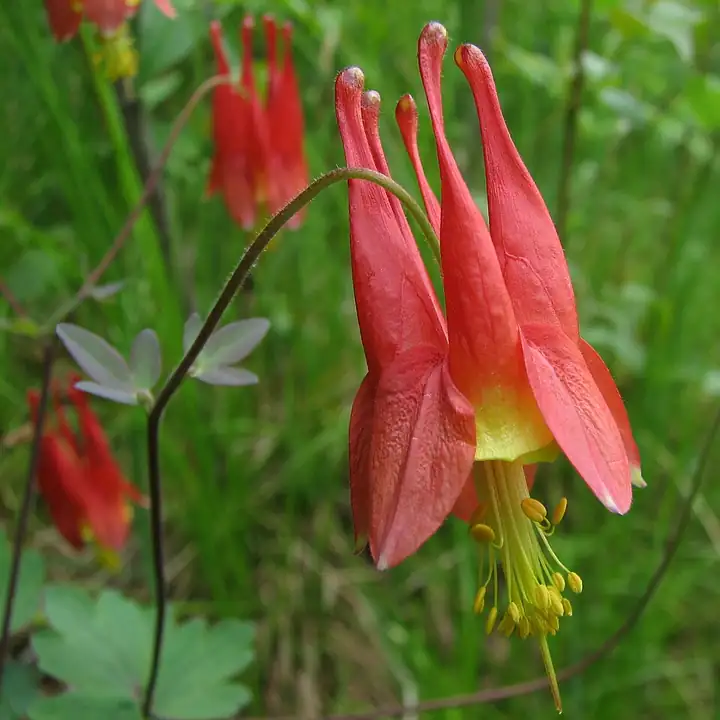
Columbine
Aquilegia spp. (incl. native eastern red columbine A. canadensis, Rocky Mountain columbine A. caerulea, European A. vulgaris and hybrids) · Buttercup family (Ranunculaceae)
When to plant: Sow seed outdoors in fall, or give it a cold, moist treatment before sowing indoors; it sprouts in about 3-4 weeks (Wisconsin Extension).
| Hardiness zones | 3 to 8 |
|---|---|
| Sun | full sun to part shade |
| Water | moderate |
| Life cycle | perennial |
| Frost | Hardy: takes frost |
About Columbine
Columbines are spring perennials with nodding, spurred flowers held over lacy blue-green leaves. Native eastern red columbine (A. canadensis), red and yellow with nectar-filled spurs, is a key food for ruby-throated hummingbirds returning in spring (Wisconsin Extension); the U.S. Forest Service notes that red columbines evolved sweeter nectar to fuel hummingbirds. Plants are short-lived, often only a few years, but they self-sow and different kinds cross freely.
Most columbines are hardy in zones 3-8 (NC State); eastern red columbine grows in zones 2-9 (Wisconsin Extension). The U.S. Forest Service asks gardeners near wild stands of native columbine to avoid planting non-native kinds, which can cross with them.
When to plant
Sow seed outdoors in fall, or give it a cold, moist treatment before sowing indoors; it sprouts in about 3-4 weeks (Wisconsin Extension).
Seedlings usually bloom their second year (NC State). Species come true from seed, but hybrids and mixed plantings give variable seedlings (Iowa State).
Soil
Rich, moist, well-drained soil; columbines dislike soggy or compacted ground and aren't very drought-tolerant, though eastern red columbine handles dry spells better (Iowa State; NC State).
Improve the bed with compost so the soil is rich, moist and well drained (Iowa State). Follow a soil test.
Feeding
- spring, as the leaves come up: all-purpose fertilizer. Iowa State feeds columbine once as the foliage emerges; follow the label rate and water it in.
Look for: a balanced or all-purpose fertilizer at the label rate. Skip high-phosphorus "bloom boosters" unless a soil test shows low phosphorus: most garden soils already have enough, and the extra can wash into streams. - when flower buds form: all-purpose fertilizer. Iowa State notes a second light feeding at bud time works well.
Look for: a balanced or all-purpose fertilizer at the label rate. Skip high-phosphorus "bloom boosters" unless a soil test shows low phosphorus: most garden soils already have enough, and the extra can wash into streams.
Columbines rot in soggy, poorly drained soil (NC State; Iowa State).
Harvest
Flowers open in spring for about a month. Deadheading reduces self-sowing and can extend bloom (Colorado State; Iowa State); cut leafminer-damaged foliage back after flowering and fresh leaves will grow (Iowa State; NC State). Blooms make good spring cut flowers (Iowa State).
Varieties (19)
| Variety | Type | Zones | Notes |
|---|---|---|---|
| Corbett | Eastern red columbine (A. canadensis) | 3–8 | Dwarf plant with sulfur-yellow flowers. Sources: [1][4] |
| Little Lanterns | Eastern red columbine (A. canadensis) | 3–8 | About 10 in tall with red and yellow flowers and blue-green leaves. Sources: [1][4] |
| Nana | Eastern red columbine (A. canadensis) | 3–8 | All-yellow flowers. Sources: [1] |
| Pink Lanterns | Eastern red columbine (A. canadensis) | 3–8 | Pink and white flowers. Sources: [1] |
| Clementine series | European columbine (A. vulgaris) | 3–8typical for columbine | Compact plants with double, upward-facing flowers in many colors. Sources: [6] |
| Munstead White (var. nivea) | European columbine (A. vulgaris) | 3–8typical for columbine | White flowers over gray-green leaves. Sources: [6] |
| Nora Barlow | European columbine (A. vulgaris) | 3–8typical for columbine | Double, pinkish flowers. Sources: [6] |
| William Guiness | European columbine (A. vulgaris) | 3–8typical for columbine | Tall plant with near-black and white flowers. Sources: [6] |
| Winky series | European columbine (A. vulgaris) | 3–8typical for columbine | Short plants with upward-facing flowers in many color combinations. Sources: [6] |
| Cameo series | Fan columbine (A. flabellata) | 3–8typical for columbine | Dwarf plants in several colors; good for rock gardens. Sources: [6] |
| Yellow Queen | Golden columbine (A. chrysantha) | 3–8typical for columbine | Lemon-yellow flowers on a 2-4 ft species. Sources: [6] |
| Biedermeier | Hybrid columbine | 3–8typical for columbine | Recommended by Colorado State; no trait details given. Sources: [7] |
| Denver Gold | Hybrid columbine | 3–8typical for columbine | Recommended by Colorado State; no trait details given. Sources: [7] |
| McKana Hybrids | Hybrid columbine | 3–8 | Mixed colors with long spurs. Hybrids often live only 1-3 years and their seedlings don't come true (Iowa State). Sources: [6][7] |
| Music (Musik) series | Hybrid columbine | 3–8 | Compact plants in mixed colors. Sources: [6][7] |
| Songbird series | Hybrid columbine | 3–8 | Named colors such as 'Bluebird', 'Cardinal', 'Blue Jay', 'Robin' and 'Dove'. Sources: [6][7] |
| Crimson Star | Rocky Mountain columbine (A. caerulea) | 3–8typical for columbine | Crimson and white flowers. Sources: [6] |
| Red Hobbit | Rocky Mountain columbine (A. caerulea) | 3–8typical for columbine | Compact plant with red and white flowers. Sources: [6] |
| var. ochroleuca | Rocky Mountain columbine (A. caerulea) | 3–8typical for columbine | White flowers. Sources: [6] |
Pests to watch for
Leafminers, Aphids, Twospotted spider mite, Sawflies (garden sawflies), Foliar nematodes
Diseases and problems
Powdery mildew, Leaf spot, Crown rot, Cucumber mosaic
In the kitchen
Safety: The U.S. Forest Service warns that mature seeds and roots contain toxins that can cause severe stomach upset and heart palpitations. Don't eat any part of the plant, and keep seed heads away from children.
Pets: Not listed as toxic by the ASPCA (columbine has no ASPCA entry), but the U.S. Forest Service says the seeds and roots are toxic, so discourage pets from chewing them.
Sources
- plants.ces.ncsu.edu
- plants.ces.ncsu.edu
- plants.ces.ncsu.edu
- hort.extension.wisc.edu
- hort.extension.wisc.edu
- yardandgarden.extension.iastate.edu
- planttalk.colostate.edu
- fs.usda.gov
- fs.usda.gov
- fs.usda.gov
- pollinators.psu.edu
- aspca.org
Photo: Photo: Ragesoss, CC BY-SA 3.0, via Wikimedia Commons (CC BY-SA 3.0). Photo resized for the web.

Planting dates and advice are general guidance; check with your local Cooperative Extension office for your area.