
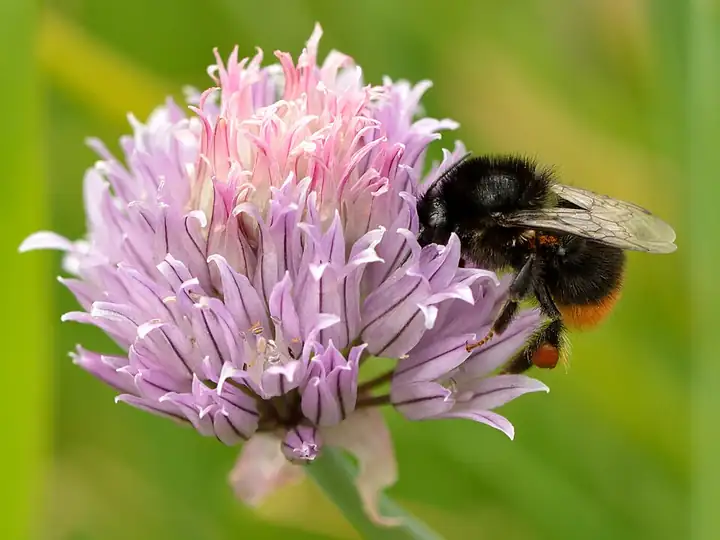
Chives
Allium schoenoprasum · Onion family (Amaryllidaceae)
When to plant: Start seeds indoors 8 to 10 weeks before the last frost, set out plants up to 2 weeks after the last frost and sow seeds outdoors up to 2 weeks after the last frost.
| Hardiness zones | 4 to 8 |
|---|---|
| Sun | full sun to part shade |
| Water | moderate |
| Life cycle | perennial |
| Frost | Hardy: takes frost |
| Soil pH | 6.0–7.0 |
| Spacing | 6 to 12 inches |
| Days to harvest | 30 to 60 days |
About Chives
Chives are a tough, clump-forming perennial with mild onion-flavored leaves and edible purple flowers. One planting comes back for years and is easy to divide and share.
NC State lists chives as hardy in zones 4-8; the leaves die back in winter and regrow in spring.
When to plant
Timing is counted from your average last spring frost (and first fall frost). Sow & Tell works out the actual dates for your ZIP code.
- Start seeds indoors: 8 to 10 weeks before the last frost
- Set out plants: up to 2 weeks after the last frost
- Sow seeds outdoors: up to 2 weeks after the last frost
Start seed indoors 8-10 weeks before the last frost or sow outdoors after it; rooted clumps set out after frost are easiest. First harvest is about 60 days from seed or 30 days from transplants (USU). Divide clumps every 3-4 years in early spring or fall.
Soil
Adapts to clay, loam or sandy soil as long as it drains well.
Follow a soil test; work in no more than 1 inch of well-rotted compost per 100 sq ft, and aim for a soil pH of 6.0 to 7.0 in well-drained soil rich in organic matter.
Feeding
- May: nitrogen fertilizer such as 21-0-0. Sprinkle about 1 tsp per square foot around the clump and water it in.
Look for: a light, all-purpose or nitrogen fertilizer. Herbs are grown for fresh leaves to pick, so a little nitrogen keeps new growth coming; most need only light feeding. - July: nitrogen fertilizer such as 21-0-0. Sprinkle about 1 tsp per square foot around the clump and water it in.
Look for: a light, all-purpose or nitrogen fertilizer. Herbs are grown for fresh leaves to pick, so a little nitrogen keeps new growth coming; most need only light feeding.
Too much fertilizer can hurt chives; slower, compact growth gives stronger flavor and healthier plants. Established clumps only need a very light spring feeding if heavy cutting weakens them.
Harvest
Begin cutting once plants are about 6 inches tall, clipping leaves at the base. The flowers are edible too.
Snip leaves at the base of the plant as needed, all season, year after year. Cut off flower stalks at the soil line after bloom to keep plants productive, and divide clumps every 3 to 4 years.
Varieties (17)
| Variety | Type | Season and days | Zones | Notes |
|---|---|---|---|---|
| Album | Chives | 4–8typical for Chives (Allium schoenoprasum) | White-flowered form of chives. Sources: [1][6] | |
| Dolores | Chives | 4–8typical for Chives (Allium schoenoprasum) | Seed-grown cooking type with narrow, dark green leaves and an even, upright habit. Sources: [1][6] | |
| Forescate | Chives | 4–8typical for Chives (Allium schoenoprasum) | Vigorous, 18-20 inches tall, with larger, brighter rose-pink flowers than the species. Sources: [1][6][8] | |
| Grolau | Chives | 4–8typical for Chives (Allium schoenoprasum) | Extra-strong flavor. Swiss strain bred for indoor growing, with thick, dark leaves that are less likely to get leggy. Sources: [1][7][8] | |
| Marsha | Chives | 4–8typical for Chives (Allium schoenoprasum) | Very deep purple flowers. Sources: [1][6] | |
| Nelly | Chives | 4–8typical for Chives (Allium schoenoprasum) | Fine, blue-green leaves with a uniform upright habit. Sources: [1][7] | |
| Pink Giant | Chives | 4–8typical for Chives (Allium schoenoprasum) | Taller than other chives, with blue-green leaves about twice normal size and large clear pink flowers. Sources: [1][6] | |
| Pink Perfection | Chives | 4–8typical for Chives (Allium schoenoprasum) | Pink-flowered chives that hold the Royal Horticultural Society Award of Garden Merit. Sources: [1] | |
| Profusion | Chives | 4–8typical for Chives (Allium schoenoprasum) | Sterile flowers that set no seed, so it blooms longer and does not self-sow; many tender flowers; good in pots. Sources: [1][6][7][8] | |
| Snowcap | Chives | 4–8typical for Chives (Allium schoenoprasum) | Semi-dwarf, white-flowered, 12-15 inches tall. Sources: [1][6] | |
| Staro | Chives | 4–8typical for Chives (Allium schoenoprasum) | Extra-thick, dark leaves. Sources: [1][7] | |
| Common chives | Chives (Allium schoenoprasum) | 80 days | 4–8 | Mild onion flavor; the flowers are edible too. Clumps of hollow, grass-like leaves 12-18 inches tall with pale purple ball-shaped flowers in spring. Grows well indoors over winter (Arkansas Extension). Sources: [1][4][9][10] |
| Geisha | Garlic chives | 3–9typical for Garlic chives (Allium tuberosum) | 2015 All-America Selections winner. Sources: [11][12][13] | |
| Kobold | Garlic chives | 3–9typical for Garlic chives (Allium tuberosum) | More compact and uniform than typical garlic chives. Sources: [7][13] | |
| Garlic chives | Garlic chives (Allium tuberosum) | 80 days | 3–9 | Mild garlic flavor, between garlic and onion. Flat leaves and fragrant white flowers in late summer; about 12-18 inches tall. Self-seeds and spreads by rhizomes and can get weedy; cut off flowers before seed forms. Also called Chinese chives. Sources: [4][7][9][10][13] |
| Curly chives | Ornamental chives | 55 days | 4–8typical for chives | Flat, curled and twisted leaves with large pink flowers; suits rock gardens. Sources: [9] |
| Curly Mauve | Ornamental chives | 4–8typical for chives | Low foliage that curls in all directions, with upright gray-lavender flowers. Sources: [6] |
Pests to watch for
Diseases and problems
In the kitchen
Leaves and flowers are eaten raw in salads and sandwiches or cooked in soups.
Keeping it: Chives are best cut fresh right before you use them. Snipped extras keep a few days in the refrigerator with the stems in a little water.
Pets: Toxic to dogs, cats and horses (ASPCA): n-propyl disulfide can cause vomiting and break down red blood cells (anemia)
Sources
- plants.ces.ncsu.edu
- extension.umn.edu
- aspca.org
- extension.umn.edu
- extension.usu.edu
- hort.extension.wisc.edu
- extension.illinois.edu
- pss.uvm.edu
- uaex.uada.edu
- hgic.clemson.edu
- all-americaselections.org
- all-americaselections.org
- plants.ces.ncsu.edu
Photo: Photo: Ivar Leidus, CC BY-SA 4.0, via Wikimedia Commons (CC BY-SA 4.0). Photo resized for the web.

Planting dates and advice are general guidance; check with your local Cooperative Extension office for your area.