
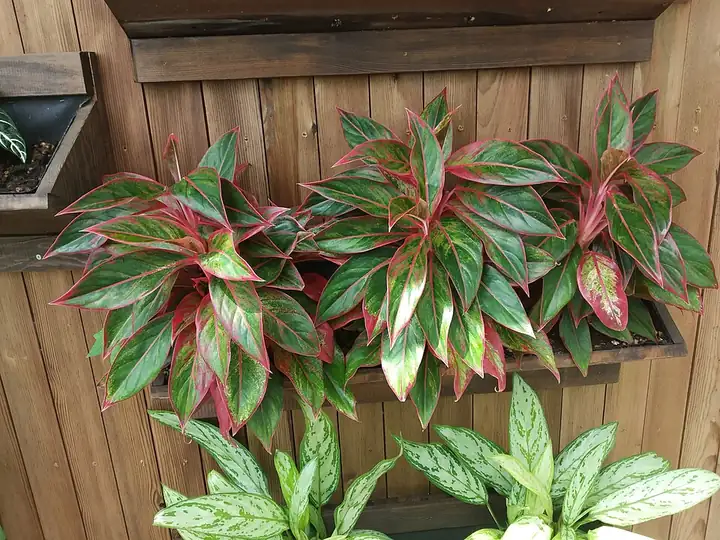
Chinese evergreen
Aglaonema commutatum, A. modestum and hybrids · Arum family (Araceae)
When to plant: Any time of year, since it grows indoors. Repot in spring when roots fill the pot, one size up, and divide it or take tip cuttings then.
| Hardiness zones | 10 to 11 |
|---|---|
| Sun | shade |
| Water | moderate |
| Life cycle | perennial |
| Frost | Tender: killed by frost |
Will it grow in your window?
Pick the window it sits in. This is the same check Sow & Tell runs for every plant in your house.
It wants low light.
Pick a window above and this will tell you whether the spot suits it.
Watering: water when the top inch is dry — about every 7 days, stretching to every 12 from November to February.
Summering outside? Bring it in before nights drop below 65°F.
About Chinese evergreen
Chinese evergreens are clumping foliage plants from the forest floors of Southeast Asia and New Guinea, grown for lance-shaped leaves splashed with silver, cream, pink or red (NC State). They are among the best plants for a dim room: a north window or ordinary room light keeps them going for years, and newer pink and red kinds bred in Florida are as tough as the old silver ones. The one thing they hate is cold, so keep them away from drafty doors.
Hardy outdoors only in zones 10b-11 (NC State); it is grown indoors everywhere and can summer outdoors in full shade once nights stay above about 65 F.
When to plant
Any time of year, since it grows indoors. Repot in spring when roots fill the pot, one size up, and divide it or take tip cuttings then.
Usually bought as a nursery plant or started from a division or tip cutting of an older plant (NC State, Illinois Extension).
Growing it indoors
- Light: One of the best plants for low light; shadowless light from a north window or good indirect light suits it, and bright light bleaches the leaves (NC State, Illinois Extension, Penn State).
- Water: Keep the mix lightly moist from spring through fall, letting the surface dry between waterings, and always use room-temperature water, since cold water invites root rot (NC State, Illinois Extension). Water less in winter.
- Humidity: Prefers high humidity but tolerates dry rooms; leaves brown at the edges in very dry air or drafty spots (NC State).
- Temperature: Likes 70-80 F days (NC State) and about 65 F nights (MU Extension); chilling injury starts below 45 F (UF/IFAS), so keep it off cold windowsills and away from doors and AC vents.
- Feeding: No page we opened gives a plant-specific rate; follow MU Extension's general rule of a complete houseplant fertilizer about once a month while new leaves appear, none in winter.
- Repotting: No page we opened gives a schedule; repot in spring when roots fill the pot, one size up (MU Extension), and cut leggy stems back at the same time.
- More plants: Divide the clump at repotting, or take tip cuttings when stems get too long; air layering also works (NC State, Illinois Extension).
If something looks wrong
| What you see | Likely cause | What to do |
|---|---|---|
| Brown leaf edges | Very dry air or a drafty spot | Move it out of the draft and set it on a pebble tray or group it with other plants (NC State). |
| Yellow leaves and soft stems, mix soggy | Root rot from overwatering, cold water or cold temperatures | Let the mix dry, water with room-temperature water, and repot if roots are brown (NC State, Oklahoma State). |
| Leaves fading to pale or bleached | Too much light | Move it to lower light gradually over a few weeks (Penn State). |
| Long bare stems with leaves only at the top | Normal with age | Cut the stems back and root the tips as cuttings (NC State, Illinois Extension). |
Soil
A standard potting mix with good drainage, kept lightly moist spring through fall (NC State).
Pot in a standard potting mix with good drainage (NC State).
Feeding
- Spring through fall, while new leaves appear: complete water-soluble houseplant fertilizer. No opened page gives a plant-specific rate; MU Extension's general houseplant rule is about once a month at label strength, or 20-20-20 at 1.5 teaspoons per gallon, watered in.
- Winter: none. Skip fertilizer and water less while growth pauses (NC State, MU Extension).
Cold water and cold rooms do more harm than a missed feeding; use room-temperature water and keep it above 65 F at night (NC State, MU Extension).
Varieties (9)
NC State lists dozens of cultivars; the 9 described by NC State and UF/IFAS are included.
| Variety | Type | Zones | Notes |
|---|---|---|---|
| Maria | Dark green | 10–11typical for chinese evergreen | Compact A. commutatum with dark green leaves lightly feathered in silver; good in very low light. Sources: [1] |
| Favonian | Pink-leaved | 10–11typical for chinese evergreen | Pink leaves with green edging, veins and stems. Sources: [1][3] |
| Golden Fluorite | Pink-leaved | 10–11typical for chinese evergreen | Dark green to pale yellow leaves with a pink center. Sources: [1][3] |
| Harlequin | Pink-leaved | 10–11typical for chinese evergreen | Dark green leaves splotched with yellow and veined in pink. Sources: [1][3] |
| Lady Valentine | Pink-leaved | 10–11typical for chinese evergreen | Pink and green foliage. Sources: [1][3] |
| Red Emerald | Red-leaved | 10–11typical for chinese evergreen | Green leaves flushed and edged red; Penn State notes its leaves bleach in bright light and fade when moved to dim light, so acclimate it slowly. Sources: [1][5] |
| Emerald Bay | Silver-leaved | 10–11typical for chinese evergreen | Silvery-green leaves with darker dapples along the margin; a University of Florida release. Sources: [1][3] |
| Silver Bay | Silver-leaved | 10–11typical for chinese evergreen | A widely grown A. commutatum selection with broad leaves centered in silver-green. Sources: [1] |
| Silver Queen | Silver-leaved | 10–11typical for chinese evergreen | An older silver-and-green hybrid still common in homes and offices. Sources: [1] |
Pests to watch for
Diseases and problems
Root and crown rot, Leaf spot, Stem rot
In the kitchen
Safety: All parts contain calcium oxalate crystals: eating it causes a painful, burning mouth and swelling of the lips and tongue, and the sap can give a rash (NC State rates it low severity; UF/IFAS). The red berries are not edible. Keep it from small children and wash hands after cutting it.
Pets: Toxic to dogs, cats and horses (ASPCA, listed as Aglaonema modestum): insoluble calcium oxalates cause oral irritation, pain and swelling of the mouth, tongue and lips, heavy drooling, vomiting (not in horses) and trouble swallowing.
Sources
- plants.ces.ncsu.edu
- extension.illinois.edu
- blogs.ifas.ufl.edu
- extension.okstate.edu
- extension.psu.edu
- extension.missouri.edu
- aspca.org
Photo: Photo: Satirdan kahraman, CC0, via Wikimedia Commons (CC0). Photo resized for the web.

Planting dates and advice are general guidance; check with your local Cooperative Extension office for your area.