
Cardoon
Cynara cardunculus · Daisy family (Asteraceae)
When to plant: Oregon State starts seed in a greenhouse in early to mid-March and sets plants out in mid-May (or direct-seeds in May) for an October to November harvest; Illinois gardeners start seed indoors in late January or early February.
| Hardiness zones | 7 to 10 |
|---|---|
| Sun | full sun |
| Water | moderate |
| Life cycle | perennial |
| Frost | Half-hardy: takes a light frost |
| Spacing | 18 to 24 inches |
| Days to harvest | 120 to 150 days |
About Cardoon
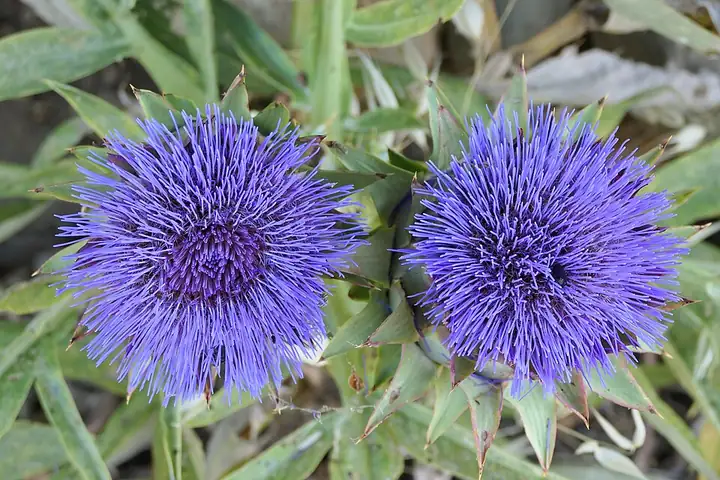
Cardoon is a tall, thistle-like cousin of the globe artichoke grown for its thick leaf stalks, which are tied up and blanched in fall and then cooked. Its silvery leaves and purple flowers also make it a striking ornamental. In California the wild form (artichoke thistle) is an invasive weed: it is on the state noxious weed list and Cal-IPC rates it Moderate, so cut flower heads before they set seed.
Perennial where winters are mild (NC State lists zones 7-10); elsewhere grow it as an annual from transplants. It is touchy about frost and turns bitter in hot weather, doing best with cool summers.
When to plant
Oregon State starts seed in a greenhouse in early to mid-March and sets plants out in mid-May (or direct-seeds in May) for an October to November harvest; Illinois gardeners start seed indoors in late January or early February.
Days count from planting. Plant in a shallow trench and fill it in as plants grow.
Soil
Deep, fertile, well-drained soil with room for the large taproot; water evenly, since drought makes stalks pithy.
Work plenty of manure or compost into deep, fertile soil before planting, and follow a soil test for phosphorus and potassium.
Feeding
- early spring, before flower buds form: nitrogen fertilizer. Oregon State applies the nitrogen all at once at this stage; spread it around the plants and water it in.
Look for: high nitrogen (the first number biggest), such as 21-0-0. Leafy crops are grown for their leaves, and nitrogen grows leaves.
Don't let plants go short of water: drought makes the stalks pithy, and hot weather makes them bitter.
Harvest
Near maturity, tie the leaves together and wrap the plant in burlap or paper for 4 to 5 weeks to blanch it. Then cut just below the crown and trim to the pale heart of stalks.
Each plant is blanched and cut once, in fall. Where it is perennial (about zone 7 and warmer) it regrows from its taproot for another fall harvest; where it is grown as an annual, it is a single harvest.
Varieties (6)
Oregon State names 6 cardoon varieties, with few details; it advises choosing spineless types over spiny ones.
| Variety | Zones | Notes |
|---|---|---|
| Bianco Ameliore | 7–10typical for cardoon | Suggested by Oregon State as suitable for trial. Sources: [2] |
| Gigante | 7–10typical for cardoon | Named by Oregon State as a variety in current catalogs. Sources: [2] |
| Italian Dwarf | 7–10typical for cardoon | Suggested by Oregon State as suitable for trial. Sources: [2] |
| Large Smooth | 7–10typical for cardoon | Suggested by Oregon State as suitable for trial. Sources: [2] |
| Tenderheart | 7–10typical for cardoon | Named by Oregon State as a variety in current catalogs. Sources: [2] |
| White Improved | 7–10typical for cardoon | Suggested by Oregon State as suitable for trial. Sources: [2] |
Pests to watch for
Diseases and problems
In the kitchen
The blanched inner leaf stalks are trimmed and cooked as a vegetable, prized in Mediterranean cooking. The roots can be cooked too, and the flower heads can be eaten like small, less meaty artichokes.
Keeping it: Cardoon is best used fresh; kept at about 32F with high humidity, it holds 2 to 3 weeks.
Safety: Many types have sharp spines on the stems and leaves, so wear gloves when tying, blanching and trimming (NC State).
Pets: Not listed by the ASPCA
Sources
- plants.ces.ncsu.edu
- horticulture.oregonstate.edu
- extension.illinois.edu
- cal-ipc.org
- ceb.bio.uci.edu
- cdfa.ca.gov
- aspca.org
- aspca.org
Photo: Photo: Petro Stelte, CC BY-SA 4.0, via Wikimedia Commons (CC BY-SA 4.0). Photo resized for the web.

Planting dates and advice are general guidance; check with your local Cooperative Extension office for your area.