
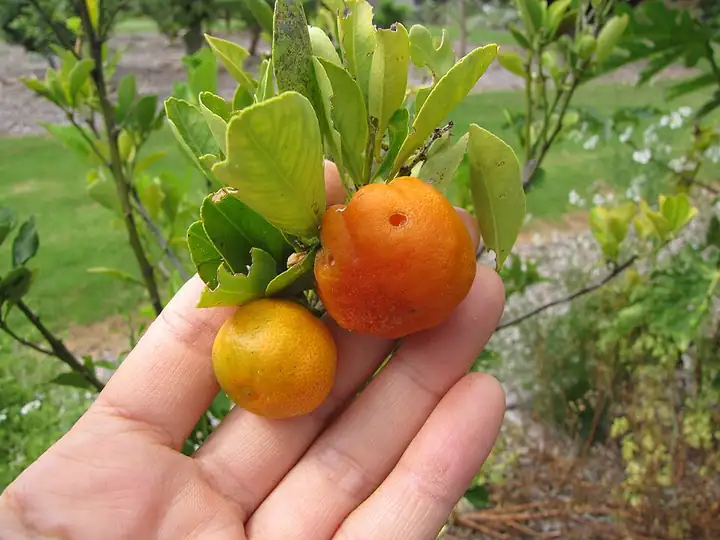
Calamondin
Citrus x microcarpa (formerly x Citrofortunella microcarpa) · Citrus family (Rutaceae)
When to plant: Set out plants up to 2 weeks after the last frost.
| Hardiness zones | 8 to 11 |
|---|---|
| Sun | full sun |
| Water | moderate |
| Life cycle | perennial |
| Frost | Half-hardy: takes a light frost |
| Soil pH | 5.5–6.5 |
About Calamondin
Calamondin, called calamansi in the Philippines, is a small, upright, nearly thornless citrus thought to be a natural cross of a sour mandarin and a kumquat. It bears loads of tiny, very sour orange fruit and fragrant white flowers much of the year. It is the citrus most often grown as a houseplant.
NC State lists zones 8b-11b; UF says it is hardy to about 22 F once established, and young trees need protection.
When to plant
Timing is counted from your average last spring frost (and first fall frost). Sow & Tell works out the actual dates for your ZIP code.
- Set out plants: up to 2 weeks after the last frost
A potted tree goes outside after the last spring frost and is eased into full sun over about two weeks (Maryland Extension; Wisconsin says wait until temperatures stay above 50 F). Budded citrus usually starts bearing in its second or third year (Texas A&M).
Soil
Well-drained soil rich in organic matter, acid to neutral (NC State); in pots a fast-draining mix with some peat (Minnesota Extension).
Pot it in a fast-draining, slightly acid potting mix (bark-based, or palm-and-cactus mix) in a container with drainage holes, never garden soil; in the ground, test the soil and keep the pH around 6.0-7.0 (Mississippi State; UC Master Gardeners; UGA).
Feeding
- First feeding after planting, once new growth starts (about 4 to 6 weeks): citrus fertilizer with micronutrients (about a 2-1-1 or 3-1-1 N-P-K ratio with iron, manganese and zinc, or a slow-release 12-6-6 or 12-4-6). Follow the label for a pot; in the ground, UGA starts a young tree with about 1/3 lb of 8-8-8 with micronutrients spread in a 30-inch circle and watered in.
Look for: mostly nitrogen, in spring as growth starts. Spring feeding grows the new shoots and leaves that carry flowers and fruit; feeding after midsummer pushes soft growth that may not harden before winter. - Early spring each year, as new growth begins: citrus fertilizer with micronutrients (N-P-K about 2-1-1 or 3-1-1). Slow-release granules need 2 to 3 feedings a season; a water-soluble citrus food can instead go on about once a month from late winter to fall (Clemson; Maryland; UC Master Gardeners; Texas A&M).
Look for: mostly nitrogen, in spring as growth starts. Spring feeding grows the new shoots and leaves that carry flowers and fruit; feeding after midsummer pushes soft growth that may not harden before winter. - Early summer: citrus fertilizer with micronutrients. Repeat the spring feeding at the label rate and water it in (Maryland Extension).
Look for: mostly nitrogen, in spring as growth starts. Spring feeding grows the new shoots and leaves that carry flowers and fruit; feeding after midsummer pushes soft growth that may not harden before winter. - Late summer (the last feeding of the year): citrus fertilizer with micronutrients. Give the final feeding, then stop by early fall so new growth can harden before winter; in the ground, UGA says no fertilizer from August 1 to February 15.
Look for: mostly nitrogen, in spring as growth starts. Spring feeding grows the new shoots and leaves that carry flowers and fruit; feeding after midsummer pushes soft growth that may not harden before winter. - Any time young leaves turn yellow with green veins: chelated iron fertilizer or a sulfur soil acidifier. Apply as the label directs; this pattern usually means iron is short or the mix is not acid enough (Maryland Extension).
Look for: mostly nitrogen, in spring as growth starts. Spring feeding grows the new shoots and leaves that carry flowers and fruit; feeding after midsummer pushes soft growth that may not harden before winter.
Don't feed through the winter indoors (Wisconsin and Minnesota feed only about April to September), and don't overwater or let the root ball dry out: too much water drops leaves and too little drops flowers (Maryland; Mississippi State).
Harvest
Fruit starts green and turns orange as it ripens, which can take up to a year; trees flower and fruit on and off all year (NC State; UC Riverside).
Calamondin blooms in spring and then repeats 4 to 5 times through the season, so a tree often has flowers and fruit at once. Fruit can take up to a year to ripen, so pick as fruits turn orange.
Varieties (2)
Only two garden forms are documented: the regular calamondin and the variegated form. UC Riverside also keeps a few research selections that are not sold.
| Variety | Type | Season and days | Zones | Notes |
|---|---|---|---|---|
| Calamondin (standard) | Calamondin | Flowers and fruits off and on all year | 8–11typical for calamondin | Very sour, juicy flesh with a thin, sweet, edible rind. Small, round orange fruit with few small seeds. Upright, columnar, nearly thornless tree with small dense leaves. Probably from China and important in the Philippines as calamansi. Sources: [1][6] |
| Variegated calamondin ('Peters') | Calamondin (variegated sport) | Year round | 8–11typical for calamondin | Acidic and juicy, like regular calamondin. Leaves marbled light green and cream; young fruit faintly striped, turning solid orange. Fruit smaller and paler than regular calamondin. A branch mutation found on a regular calamondin; received by UC Riverside from Altadena, California, in 1954. Sources: [7] |
Pests to watch for
Scale insects, Mealybugs, Whiteflies, Twospotted spider mite, Aphids, Citrus leafminer, Asian citrus psyllid
Diseases and problems
Root rot, Sooty mold, Citrus greening (HLB)
In the kitchen
Too sour to eat out of hand; the juice is used like lemon or lime in drinks and cooking, and it is an important juice fruit in the Philippines (UF/IFAS; NC State; UC Riverside).
Keeping it: Fruit holds well on the tree, so pick as needed. Like other citrus, picked fruit keeps a few days on the counter or longer in the refrigerator.
Safety: The fruit is eaten as a food. The sources we checked list no toxic parts for people, and we found no research-based guidance on pregnancy, drug interactions or allergies.
Pets: Toxic to dogs, cats and horses (ASPCA, listed as calamondin orange): essential oils and psoralens can cause vomiting, diarrhea, depression and sun-sensitive skin irritation.
Sources
- plants.ces.ncsu.edu
- gardeningsolutions.ifas.ufl.edu
- ufdcimages.uflib.ufl.edu
- fieldreport.caes.uga.edu
- extension.umn.edu
- citrusvariety.ucr.edu
- citrusvariety.ucr.edu
- aggie-horticulture.tamu.edu
- extension.msstate.edu
- hort.extension.wisc.edu
- extension.umd.edu
- ucanr.edu
- hgic.clemson.edu
- aspca.org
- aphis.usda.gov
- usda.gov
- sandiegocounty.gov
- agrilifetoday.tamu.edu
Photo: Photo: Forest and Kim Starr, CC BY 3.0 us, via Wikimedia Commons (CC BY 3.0 us). Photo resized for the web.

Planting dates and advice are general guidance; check with your local Cooperative Extension office for your area.