
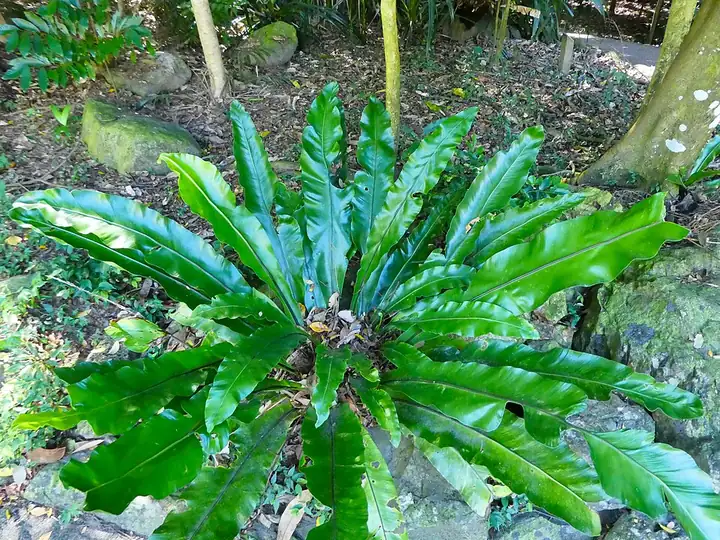
Bird's nest fern
Asplenium nidus · Spleenwort family (Aspleniaceae)
When to plant: Any time of year, since it grows indoors. It grows slowly, so move it up a pot size only when it outgrows its pot.
| Hardiness zones | 11 to 12 |
|---|---|
| Sun | shade |
| Water | high |
| Life cycle | perennial |
| Frost | Tender: killed by frost |
Will it grow in your window?
Pick the window it sits in. This is the same check Sow & Tell runs for every plant in your house.
It wants medium light.
Pick a window above and this will tell you whether the spot suits it.
Watering: keep it evenly moist — about every 4 days, stretching to every 7 from November to February.
Summering outside? Bring it in before nights drop below 55°F.
About Bird's nest fern
The bird's nest fern is a rainforest fern from Southeast Asia, Australia, Polynesia, Hawaii and Madagascar that grows on tree trunks and limbs, with broad, glossy, apple-green fronds rising in a funnel-shaped rosette (NC State). In the wild the 'nest' catches falling leaves that rot down to feed it. Unlike most ferns its fronds are undivided straps, and the dark lines in a herringbone pattern on their undersides are spore clusters, not pests.
Hardy outdoors only in zones 11-12 (NC State); it is grown indoors everywhere and can summer outdoors in shade once nights stay above about 55 F, well clear of the 40 F that kills it.
When to plant
Any time of year, since it grows indoors. It grows slowly, so move it up a pot size only when it outgrows its pot.
Usually bought as a nursery plant; it reproduces by spores and has no flowers or seeds (NC State).
Growing it indoors
- Light: Bright light or light shade, such as a north-facing window, suits it; too much sun turns the fronds yellow and stops growth (NC State).
- Water: Keep the porous mix moist but well drained; it doesn't tolerate drying out (NC State). Water until it drains, empty the tray, and use room-temperature water rather than softened water (UMN, for tropical ferns).
- Humidity: A tray of wet pebbles may be needed to keep the air humid enough (NC State); UMN prefers a room humidifier to misting for ferns.
- Temperature: NC State gives 60-70 F as ideal and says it won't survive below 40 F; MU Extension's rule for ferns is nights around 55 F. Keep it away from drafts and direct heat (NC State).
- Feeding: During active growth, a dilute liquid fertilizer about once a month (NC State); UMN warns that ferns are easily burned by overfeeding.
- Repotting: The pages we opened give no schedule; it grows slowly, so move it up a pot size in a peat-rich fern mix only when it outgrows its pot (UMN's advice for tropical ferns).
- More plants: It reproduces by spores, which form in lines under the fronds; NC State doesn't describe a home method, so new plants usually come from a nursery.
If something looks wrong
| What you see | Likely cause | What to do |
|---|---|---|
| Fronds turning yellow and new growth stalled | Too much sun | Move it to light shade, such as a north window (NC State). |
| Brown, dry frond edges | Dry air, heat or drafts | Raise the humidity with a pebble tray or humidifier and move it away from heat sources and drafts (NC State, UMN). |
| Spots or blotches spreading on the fronds after spraying | Insecticide injury or a bacterial leaf disease | Cut off damaged fronds and keep insecticide sprays off it (NC State). |
| Brown or cottony bumps scattered on the fronds and midrib | Scale or mealybugs (spore lines, by contrast, sit in neat parallel rows) | Wipe them off by hand or wash the fronds in lukewarm water with a few drops of mild dish soap (NC State, UMN). |
Soil
A rich, porous, moist fern mix that drains well, on the acid side (NC State).
Pot in a rich, porous, slightly acid fern mix that stays moist but drains (NC State).
Feeding
- During active growth, spring through summer: dilute liquid fertilizer. About once a month (NC State).
- When it isn't putting out new fronds: none. Hold off until new growth starts (UMN, for tropical ferns).
Ferns are easily burned by overfeeding (UMN), and NC State warns that chemical insecticides can injure this one.
Varieties (5)
NC State names 5 cultivars.
| Variety | Type | Zones | Notes |
|---|---|---|---|
| Osaka | Narrow | 11+typical for bird's nest fern | Narrow, strap-like fronds with rippled edges. Sources: [1] |
| Campio | Ruffled | 11+typical for bird's nest fern | Ruffled, feather-like green fronds. Sources: [1] |
| Crispy Wave | Ruffled | 11+typical for bird's nest fern | Sword-like, ruffled fronds. Sources: [1] |
| Antiquum | Wavy | 11+typical for bird's nest fern | Fronds with wavy edges. Sources: [1] |
| Victoria | Wavy | 11+typical for bird's nest fern | Long, tongue-shaped, wavy fronds. Sources: [1] |
Pests to watch for
Scale insects, Mealybugs, Slugs, Brown garden snail, Foliar nematodes
Diseases and problems
Bacterial leaf diseases, Insecticide injury
In the kitchen
Safety: NC State lists no poison hazard for people. The fronds are fragile and easily damaged, and NC State warns that chemical insecticides can injure it.
Pets: Not listed by the ASPCA under bird's nest fern; the ASPCA lists its close cousin, the mother fern (Asplenium bulbiferum), as non-toxic to dogs and cats.
Sources
Photo: Photo: Steve Fitzgerald, CC BY-SA 4.0, via Wikimedia Commons (CC BY-SA 4.0). Photo resized for the web.

Planting dates and advice are general guidance; check with your local Cooperative Extension office for your area.