
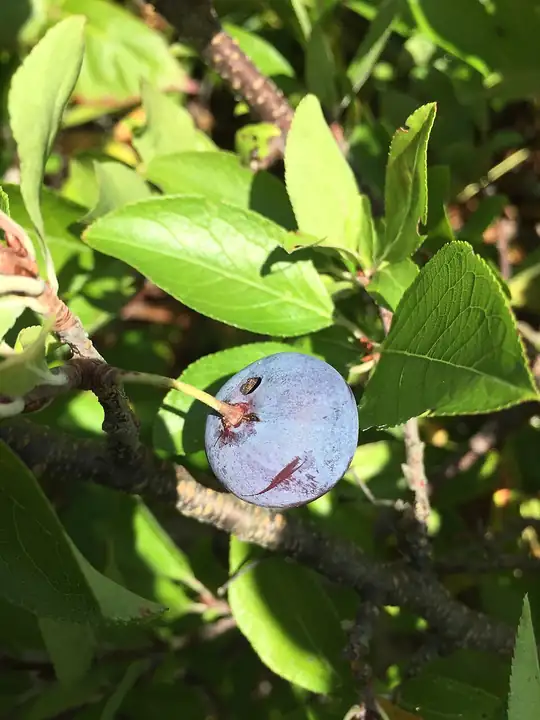
Beach plum
Prunus maritima · Rose family (Rosaceae)
When to plant: Plant bare-root or potted one-year-old plants in early spring before buds break: about 10 feet apart for single shrubs or 3-5 feet apart as a hedgerow (USDA NRCS).
| Hardiness zones | 3 to 8 |
|---|---|
| Sun | full sun |
| Water | low |
| Life cycle | perennial |
| Frost | Hardy: takes frost |
| Soil pH | 6.0–7.0 |
| Spacing | 36 to 120 inches |
About Beach plum
Beach plum is a native shrub of Atlantic coastal dunes that forms low thickets and bears small blue-purple to red plums in late summer, prized for jelly and jam. It tolerates salt and drought and needs a second plant for pollination.
Can be grown in zones 3-8; native along the coast from the Canadian Maritimes to northern Virginia (USDA NRCS). Avoid frost pockets, since cold spring nights can spoil pollination (USDA NRCS).
When to plant
Plant bare-root or potted one-year-old plants in early spring before buds break: about 10 feet apart for single shrubs or 3-5 feet apart as a hedgerow (USDA NRCS).
Shrubs begin fruiting after 3-4 growing seasons and mature in 7-8 years (USDA NRCS).
Soil
Well-drained sandy soil; tolerates salt and drought but not soggy soil (USDA NRCS).
Choose well-drained sandy soil in full sun, out of frost pockets, and amend it to a pH of 6-7.
Feeding
- Each spring after the first year, only if growth is weak: compost (a nitrogen source). Stone fruits on a good site need little feeding: skip it if last season's shoots grew 15 inches or more, and feed bearing plants only if shoots grew less than about 8 inches (University of Minnesota, for stone fruits in general).
Look for: mostly nitrogen, in spring as growth starts. Spring feeding grows the new shoots and leaves that carry flowers and fruit; feeding after midsummer pushes soft growth that may not harden before winter.
Don't plant a single shrub: beach plum is self-sterile and needs a second plant for fruit.
Harvest
Fruit ripens from late August through September and is picked by hand. Ripe plums are about 1/2 to 1 inch across and bluish-purple, dark purple or brick red, rarely yellow (USDA NRCS).
Beach plums are hand-picked once a year, late August through September. A heavy crop is often followed by a poor year; selective pruning helps even it out, and avoiding frost pockets helps pollination.
Varieties (13)
Only 13 named beach plums are documented, nearly all by the USDA NRCS plant guide, and most older ones get only a few words there. NRCS says most 1940s-era selections are rarely sold now; Ocean View is the main one available. No source rates single cultivars for hardiness. A rare yellow-fruited wild form (flava) also exists.
| Variety | Type | Season and days | Zones | Notes |
|---|---|---|---|---|
| Ocean View | Conservation release | August to October; fruit may hang on as raisins into winter | 3–8typical for beach plum | Purplish-black to red plums about 1/2 to 3/4 inch across, with a heavy waxy bloom. Upright, salt-tolerant shrub about 7 ft tall on dunes and up to about 18 ft inland; branches root where sand covers them. Chosen for vigor, disease resistance and cold tolerance. Released in 1992 by the USDA NRCS Cape May (New Jersey) Plant Materials Center for coastal dune plantings; bred from four strong strains from Delaware, New Jersey and Massachusetts. Sources: [1][6] |
| Nana | Dwarf selection | 3–8typical for beach plum | Compact, dwarf plant under 5 ft tall. Developed in Michigan. Sources: [1] | |
| Ecos | Fruit selection | 3–8typical for beach plum | Bred for better yield and disease resistance from parents with yellow and with red-blue fruit. Developed in Michigan. Sources: [1] | |
| Rutgers Jersey Jems | Fruit selection | 3–8typical for beach plum | Large, sweet fruit with little bitterness. Chosen for steady crops year after year. Released by Rutgers University in 2017. Sources: [1] | |
| Bassett's American | Fruit selection from the 1940s era | 3–8typical for beach plum | Large fruit. From New Jersey; considered the first named beach plum, picked for its big fruit. USDA NRCS says most of the older selections are hard to find for sale today. Sources: [1] | |
| Eastham | Fruit selection from the 1940s era | 3–8typical for beach plum | A Massachusetts selection chosen for fruit quality. USDA NRCS says most of the older selections are hard to find for sale today. Sources: [1] | |
| Hancock | Fruit selection from the 1940s era | 3–8typical for beach plum | A New Jersey selection chosen for fruit quality. USDA NRCS says most of the older selections are hard to find for sale today. Sources: [1] | |
| Safford | Fruit selection from the 1940s era | 3–8typical for beach plum | Sweet fruit. Heavy yields. A Massachusetts selection. USDA NRCS says most of the older selections are hard to find for sale today. Sources: [1] | |
| Squibnocket | Fruit selection from the 1940s era | 3–8typical for beach plum | Chosen for fruit quality. USDA NRCS says most of the older selections are hard to find for sale today. Sources: [1] | |
| Northneck | Older ornamental selection | 3–8typical for beach plum | Listed by USDA NRCS as an older ornamental selection. USDA NRCS says most of the older selections are hard to find for sale today. Sources: [1] | |
| Premier | Older ornamental selection | 3–8typical for beach plum | Rated highest in field trials but prone to brown rot. A Massachusetts selection. USDA NRCS says most of the older selections are hard to find for sale today. Sources: [1] | |
| Stearns | Older ornamental selection | 3–8typical for beach plum | Listed by USDA NRCS as an older ornamental selection. USDA NRCS says most of the older selections are hard to find for sale today. Sources: [1] | |
| Wheeler selection no. 6 | Older ornamental selection | 3–8typical for beach plum | A Massachusetts selection. USDA NRCS says most of the older selections are hard to find for sale today. Sources: [1] |
Pests to watch for
Plum curculio, Japanese beetle, Eastern tent caterpillar, Fall webworm, Oriental fruit moth, Birds
Diseases and problems
Brown rot, Black knot, Plum pocket, Shot hole
In the kitchen
Traditionally made into jelly and jam; also used in syrups, juice, wine and salad dressings (USDA NRCS).
Keeping it: Beach plums are soft and don't keep long: eat, cook or freeze them as soon after picking as you can (Rutgers).
Safety: Pits contain cyanide-forming compounds and can be toxic if eaten, and the leaves can poison livestock (USDA NRCS). Eat only the flesh and don't crush the pits.
Pets: Toxic to dogs, cats and horses (ASPCA lists plums and cherries, Prunus spp.): stems, leaves and seeds contain cyanogenic glycosides, especially as leaves wilt; signs include brick-red gums, dilated pupils, trouble breathing, panting and shock
Sources
- plants.sc.egov.usda.gov
- plantsservices.sc.egov.usda.gov
- aspca.org
- aspca.org
- extension.umn.edu
- npgsweb.ars-grin.gov
Photo: Photo: Famartin / Wikimedia Commons, CC BY-SA 4.0 (CC BY-SA 4.0). Photo resized for the web.

Planting dates and advice are general guidance; check with your local Cooperative Extension office for your area.