
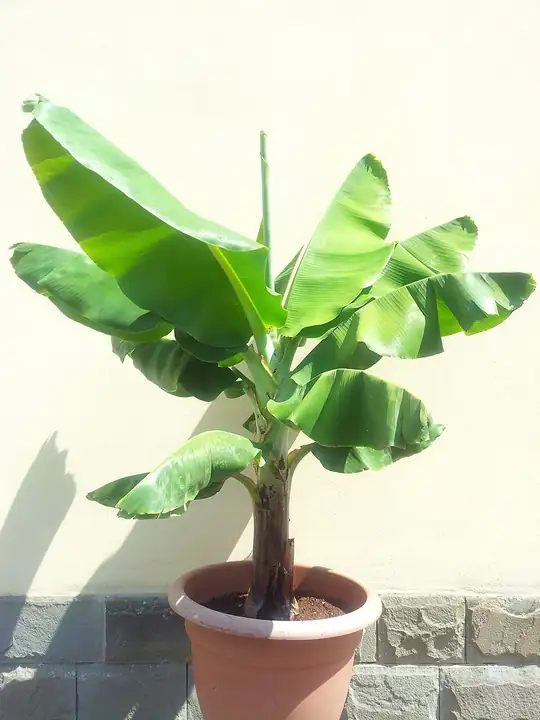
Banana (dwarf)
Musa acuminata and its hybrids (Musa spp.) · Banana family (Musaceae)
When to plant: Penn State Master Gardeners say to put a potted banana out once temperatures stay at 50 F.
| Hardiness zones | 9 to 11 |
|---|---|
| Sun | full sun |
| Water | high |
| Life cycle | perennial |
| Frost | Tender: killed by frost |
| Soil pH | 5.5–7.0 |
| Spacing | 96 to 144 inches |
About Banana (dwarf)
Bananas aren't true trees: each leafy 'trunk' (pseudostem) fruits once and is then replaced by new suckers from the underground rhizome (UF/IFAS). Dwarf types such as 'Dwarf Cavendish' stay about 6 feet tall, so they are the usual choice for a big pot that summers on the porch and winters indoors.
NC State rates bananas hardy in zones 10-11 and UF/IFAS lists zones 9b-11; in 8b-9 they fruit only where winters stay above freezing, and frost below about 28 F kills the tops to the ground (UF/IFAS). UF/IFAS does not consider Musa acuminata a problem species in Florida.
When to plant
Penn State Master Gardeners say to put a potted banana out once temperatures stay at 50 F.
In the ground, UF/IFAS suggests planting March through May; a large sucker can flower 10-15 months after planting and fruit is ready 80-180 days after the bunch appears. Space dwarf types at least 8 ft apart and tall types 12 ft or more (UF/IFAS).
Soil
Deep, well-drained soil rich in organic matter; bananas need lots of water but rot quickly in soggy or flooded ground, so drainage matters most (UF/IFAS).
Plant in deep, well-drained soil or potting mix rich in organic matter at pH 5.5-7.0; UF/IFAS says no fertilizer or topsoil is needed in the planting hole, and sandy soil can be mixed up to half and half with compost.
Feeding
- First 3-4 months after planting or after new growth starts; UF/IFAS says growth in this stretch sets the size of the bunch: high-potassium fertilizer with magnesium, such as 6-2-12 (a 3-1-6 ratio) with 2-3% magnesium. In the ground, UF/IFAS starts at about 1/2 lb per plant every 2 months; Texas A&M instead uses about 1/4 cup of ammonium sulfate a month for 3-4 months. No source gives a pot rate, so use the container rate on the label and water it in.
Look for: mostly nitrogen, in spring as growth starts. Spring feeding grows the new shoots and leaves that carry flowers and fruit; feeding after midsummer pushes soft growth that may not harden before winter. - Every 2 months through the warm growing season, feeding less from November through February: the same high-potassium fertilizer with magnesium. UF/IFAS raises in-ground amounts step by step to 5-6 lb per plant by flowering at 10-18 months; potted plants need far less, so follow the label. Add one nutritional spray a year with manganese and zinc (UF/IFAS).
Look for: mostly nitrogen, in spring as growth starts. Spring feeding grows the new shoots and leaves that carry flowers and fruit; feeding after midsummer pushes soft growth that may not harden before winter. - Potted plant indoors for winter: no fertilizer. Stop feeding and water less until new growth starts in late winter or early spring (University of Maryland).
Look for: mostly nitrogen, in spring as growth starts. Spring feeding grows the new shoots and leaves that carry flowers and fruit; feeding after midsummer pushes soft growth that may not harden before winter.
Don't overwater: bananas rot in soggy soil and timed sprinklers often drown them (UF/IFAS). Don't use weed-and-feed lawn products near the plant; they can cut fruiting (UF/IFAS).
Harvest
Cut the bunch when the fingers are plump and their edges have rounded out but before they turn yellow, then hang it in a cool, shady spot to ripen, which UF/IFAS says gives better flavor than ripening on the plant. Don't refrigerate green bananas; cold keeps them from ripening properly.
Each banana stalk fruits only once, 9 to 20 months after a sucker is planted; cut it down after harvest and a follower sucker from the same clump bears the next bunch. For steady crops, keep one fruiting stalk, one half-grown and one small sucker per clump.
Varieties (24)
| Variety | Type | Zones | Notes |
|---|---|---|---|
| Dwarf Brazilian | Apple-type dessert banana (AAB) | 9–11typical for banana | A shorter form of the apple banana grown in Hawaii. Also called Santa Catarina. Sources: [11] |
| Dwarf Cavendish | Cavendish dessert banana (AAA) | 9–11typical for banana | The familiar supermarket-type sweet banana. About 6 ft tall, the shortest Cavendish; bears large bunches of medium fruit and suffers less wind damage. Fair cold tolerance; resists Panama disease but is very susceptible to Sigatoka leaf spot. The standard pick for pots. UF/IFAS calls it better suited to the cooler subtropics than most commercial bananas. Sources: [1][3][11] |
| Grand Nain | Cavendish dessert banana (AAA) | 9–11typical for banana | Supermarket-type sweet banana. Medium-tall plant with fair cold tolerance; resists Panama disease. Also called 'Umalog'. UF/IFAS lists it for home and commercial planting. Sources: [1] |
| Lacatan | Cavendish dessert banana (AAA) | 9–11typical for banana | Supermarket-type sweet banana. The tallest Cavendish clone; fair cold tolerance and resists Panama disease. Also called Monte Cristo. A landscape plant, not a pot plant. Sources: [1] |
| Williams | Cavendish dessert banana (AAA) | Supermarket-type sweet banana. Taller than 'Dwarf Cavendish' but shorter than 'Lacatan'; fair to good cold tolerance and resists Panama disease. Also called Giant Cavendish or Giant Chinese; reported to handle cool subtropical areas. Too tall for most pots. Sources: [1][11] | |
| Ice Cream (Blue Java) | Cooking and dessert banana (ABB) | 9–11typical for banana | Small and very tasty. A larger plant, up to about 12 ft, that suckers freely; fair to good cold tolerance. Sources: [1][11][12] |
| Namwa (Pisang Awak) | Cooking and dessert banana (ABB) | 9–11typical for banana | Eaten fresh or cooked. Fair to good cold tolerance; highly susceptible to Panama disease. UF/IFAS calls the Thai 'Kluai Namwa' the leading banana in south Florida yards. A 'Dwarf Namwa' is grown in Hawaii. Sources: [1][11] |
| Orinoco (Bluggoe, Burro, Horse) | Cooking banana (ABB) | 9–11typical for banana | Not very sweet; used like a plantain when under-ripe. Coarse fruit about 6 by 2 inches. Fair to good cold tolerance, a bit hardier than most; susceptible to Panama disease, intermediate for Sigatoka. Nurseries also sell a shorter 'Dwarf Orinoco', but we found no extension source describing it. Sources: [1][3][12] |
| Saba (Cardaba) | Cooking banana (ABB) | 9–11typical for banana | Resists Panama disease. UF/IFAS lists it with 'Pelipita' as a cooking banana for home landscapes. Sources: [1] |
| Mysore | Dessert banana (AAB) | 9–11typical for banana | Good cold tolerance, resists Panama disease and is only slightly susceptible to Sigatoka. Also called Thousand Grain or Poovan. Sources: [1] |
| Pisang Raja | Dessert banana (AAB) | 9–11typical for banana | Fair cold tolerance and resists Panama disease. UF/IFAS lists it for home landscapes. Sources: [1][11] |
| FHIA-02 (Mona Lisa) | Disease-resistant hybrid (AABB) | 9–11typical for banana | Resists Sigatoka and Panama disease. UF/IFAS highly recommends it for home landscapes. Sources: [1] |
| FHIA-03 | Disease-resistant hybrid (AABB) | 9–11typical for banana | Mainly a cooking banana, but can be eaten fresh. Resists Panama disease, Moko and Sigatoka. UF/IFAS highly recommends it for home landscapes. Sources: [1] |
| FHIA-17 | Disease-resistant hybrid (AABB) | 9–11typical for banana | Dessert banana. Resists Panama disease and tolerates Sigatoka. UF/IFAS highly recommends it for home landscapes. Sources: [1] |
| FHIA-21 | Disease-resistant hybrid (AABB) | 9–11typical for banana | Eaten fresh when ripe or cooked when green. Resists black Sigatoka. UF/IFAS highly recommends it for home landscapes. Sources: [1] |
| Goldfinger (FHIA-01) | Disease-resistant hybrid (AABB) | 9–11typical for banana | A dessert banana with sweet, golden flesh and a slight lemony tang; fingers are small. Good cold tolerance; resists Panama disease and both yellow and black Sigatoka. UF/IFAS highly recommends it for home landscapes. Sources: [1][12] |
| French plantain | Plantain (AAB) | 9–11typical for banana | Starchy cooking fruit, not sweet. Fewer fruit per plant than sweet bananas; fair to poor cold tolerance; resists Panama disease. Includes 'Green French', 'Pink French' and 'Black French'. Sources: [1][12] |
| Horn plantain | Plantain (AAB) | 9–11typical for banana | Starchy cooking fruit, not sweet. Fewer fruit per bunch than sweet bananas; poor cold tolerance; resists Panama disease. Includes 'Horse plantain' and 'Dominico Gigante'. Sources: [1][12] |
| Hua Moa | Plantain-type banana (AAB) | 9–11typical for banana | Eaten fresh or cooked; UF/IFAS rates it excellent for frying green or smashing. Poor cold tolerance and susceptible to Panama disease. Needs intensive care; plant only disease-free stock in a warm, sheltered spot (UF/IFAS). Sources: [1] |
| Lady Finger (Pome, Prata) | Pome dessert banana (AAB) | 9–11typical for banana | Small, thin-skinned, very flavorful fruit about 1 inch across and 4 inches long. Tall plant with good cold tolerance, but easily damaged by wind and susceptible to Panama disease. Plant only in wind-sheltered spots free of Panama disease. The name 'Lady Finger' is also used for other, unrelated bananas. Sources: [1][2][3] |
| Dwarf Red | Red dessert banana (AAA) | 9–11typical for banana | Dwarf plant with deep burgundy-red skinned fruit; fair cold tolerance and resists Panama disease. Also listed as 'Green Red'. Sources: [1][12] |
| Red | Red dessert banana (AAA) | 9–11typical for banana | Red-skinned fruit on a full-size plant; fair cold tolerance and resists Panama disease. Also called Cuban Red or Red Jamaican. Sources: [1] |
| Apple (Silk, Manzano) | Silk dessert banana (AAB) | 9–11typical for banana | Small, sweet and pleasantly tangy with an apple-like aftertaste, but astringent unless fully soft-ripe. Medium-size plant with fair cold tolerance; susceptible to both Sigatoka and Panama disease. Plant only disease-free stock in ground that has never had Panama disease (UF/IFAS). Sources: [1][3][12] |
| Rajapuri | 9–11typical for banana | A tasty, high-quality banana. Slow to send up suckers and not wind-tolerant. Sources: [12] |
Pests to watch for
Scale insects, Twospotted spider mite, Aphids, Mealybugs, Roof rats and Norway rats
Diseases and problems
Panama disease (Fusarium wilt), Black Sigatoka, Yellow Sigatoka, Root rot
In the kitchen
Eaten fresh when ripe or cooked while green; plantain types are baked, fried or grilled (UF/IFAS). The fruit is a good source of vitamin C, vitamin B6 and potassium (UF/IFAS).
Keeping it: Ripen bananas at room temperature, never in the refrigerator while green. Once ripe and spotted, the refrigerator holds them up to about 2 weeks (the peel darkens but the fruit is fine).
Safety: The fruit is an everyday food and the sources we checked list no toxic parts. People with a latex allergy can react to bananas; MedlinePlus lists banana among the foods most strongly linked to latex allergy.
Pets: Not toxic to dogs, cats or horses (ASPCA)
Sources
- ask.ifas.ufl.edu
- ask.ifas.ufl.edu
- aggie-horticulture.tamu.edu
- plants.ces.ncsu.edu
- extension.psu.edu
- extension.missouri.edu
- extension.umd.edu
- medlineplus.gov
- aspca.org
- assessment.ifas.ufl.edu
- www3.ctahr.hawaii.edu
- blogs.ifas.ufl.edu
Photo: Photo: Iacopo Lorenzini, CC BY-SA 3.0, via Wikimedia Commons (CC BY-SA 3.0). Photo resized for the web.

Planting dates and advice are general guidance; check with your local Cooperative Extension office for your area.