
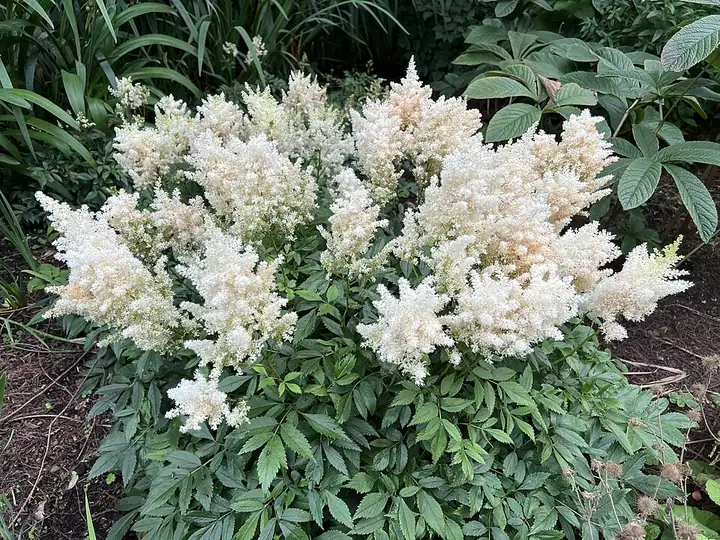
Astilbe (false spirea)
Astilbe x arendsii and other Astilbe hybrids · Saxifrage family (Saxifragaceae)
When to plant: Plant nursery plants in spring or fall in part shade.
| Hardiness zones | 3 to 9 |
|---|---|
| Sun | part shade |
| Water | high |
| Life cycle | perennial |
| Frost | Hardy: takes frost |
About Astilbe (false spirea)
Astilbe brings feathery plumes of red, pink, purple or white flowers to shady, moist beds, over fern-like leaves. Most garden kinds are hybrids bred in Germany by George Arends in the 1920s (NC State). The dried plumes stay on the plant into fall and winter.
Hardy in zones 3-9 (NC State); leaves brown in hot, dry summers unless the soil stays moist.
When to plant
Plant nursery plants in spring or fall in part shade.
Divide about every 4 years, in spring or fall (NC State). Keep the soil evenly moist, especially in sun or hot, dry spells.
Soil
Rich, moist but well-drained soil high in organic matter; it can take full sun only if the soil never dries out (NC State).
Work in organic matter so the soil stays rich and moist but drains well (NC State).
Feeding
Look for: a balanced or all-purpose fertilizer at the label rate. Skip high-phosphorus "bloom boosters" unless a soil test shows low phosphorus: most garden soils already have enough, and the extra can wash into streams.
Keep the soil evenly moist, especially in sun and in hot, dry spells; leaves brown and decline in drought (NC State). Our sources give no feeding schedule; follow a soil test.
Harvest
Blooms from late spring to late summer, depending on the kind (NC State). Leave the spent plumes on the plant; they dry and stay attractive through fall and winter.
Varieties (14)
NC State documents 14 Arends hybrid cultivars, mostly by flower color.
| Variety | Type | Zones | Notes |
|---|---|---|---|
| America (Amerika) | Arends hybrid | 3–9typical for astilbe | Violet-rose plumes. Sources: [1] |
| Amethyst | Arends hybrid | 3–9typical for astilbe | Lilac-purple plumes. Sources: [1] |
| August Light | Arends hybrid | 3–9typical for astilbe | Scarlet plumes; red spring leaves turn green. Sources: [1] |
| Bridal Veil | Arends hybrid | 3–9typical for astilbe | Pure white plumes fading to cream. Sources: [1] |
| Diamond (Diamant) | Arends hybrid | 3–9typical for astilbe | Pure white plumes; medium green leaves. Sources: [1] |
| Erica (Erika) | Arends hybrid | 3–9typical for astilbe | Pink plumes; bronze-tinted leaves. Sources: [1] |
| Fanal | Arends hybrid | 3–9typical for astilbe | Deep red plumes; dark green leaves. Sources: [1] |
| Federsee | Arends hybrid | 3–9typical for astilbe | Rosy-pink plumes. Sources: [1] |
| Gloria Purpurea | Arends hybrid | 3–9typical for astilbe | Violet-pink plumes. Sources: [1] |
| Grete Pungel | Arends hybrid | 3–9typical for astilbe | Peach-pink plumes. Sources: [1] |
| Mars | Arends hybrid | 3–9typical for astilbe | Violet-rose plumes. Sources: [1] |
| Radius | Arends hybrid | 3–9typical for astilbe | Pink plumes. Sources: [1] |
| Venus | Arends hybrid | 3–9typical for astilbe | Vivid pink plumes. Sources: [1] |
| White Glory (Weisse Gloria) | Arends hybrid | 3–9typical for astilbe | Pure white plumes; dark green leaves. Sources: [1] |
Pests to watch for
Diseases and problems
Powdery mildew, Bacterial leaf spot, Cercospora leaf spot
In the kitchen
Pets: Not listed as toxic by the ASPCA.
Sources
Photo: Photo: Eddie Johnston / Wikimedia Commons, CC BY-SA 4.0 (CC BY-SA 4.0). Photo resized for the web.

Planting dates and advice are general guidance; check with your local Cooperative Extension office for your area.