
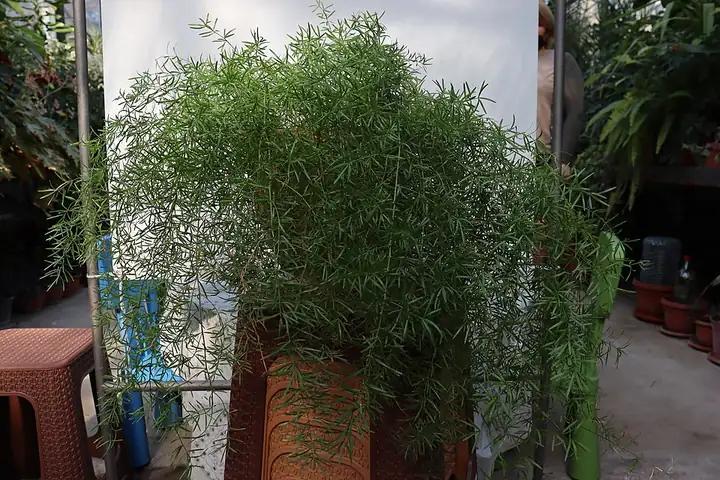
Asparagus fern
Asparagus aethiopicus 'Sprengeri' (sold as A. densiflorus) and A. setaceus (plumosa fern) · Asparagus family (Asparagaceae)
When to plant: Any time of year, since it grows indoors. Repot or divide the roots in early spring, before new growth; it outgrows pots fast.
| Hardiness zones | 9 to 12 |
|---|---|
| Sun | full sun to part shade |
| Water | moderate |
| Life cycle | perennial |
| Frost | Tender: killed by frost |
Will it grow in your window?
Pick the window it sits in. This is the same check Sow & Tell runs for every plant in your house.
It wants bright, indirect light.
Pick a window above and this will tell you whether the spot suits it.
Watering: keep it evenly moist — about every 4 days, stretching to every 7 from November to February.
Summering outside? Bring it in before nights drop below 50°F.
About Asparagus fern
Asparagus fern isn't a fern at all but a cousin of garden asparagus from southern and eastern Africa, with feathery 'leaves' that are really flattened stems, wiry spiny stems and thick water-storing tubers (Wisconsin, NC State). Sprenger's asparagus (A. aethiopicus, sold as A. densiflorus 'Sprengeri' or 'Meyeri') arches from hanging baskets, while the plumosa or lace fern (A. setaceus) is finer and climbs. Birds spread the berries, and in Florida A. aethiopicus is a Category I invasive that UF/IFAS says not to plant in landscapes; the berries are poisonous to people and pets.
Hardy outdoors in about zones 9-12 (NC State for A. setaceus; Wisconsin says Sprengeri types from zone 9, with roots often surviving to zone 7 if protected). It is grown indoors everywhere and can summer outdoors in shade once nights stay above about 50-55 F; it is a listed invasive in Florida and on a watch list in California, so keep it potted in warm states.
When to plant
Any time of year, since it grows indoors. Repot or divide the roots in early spring, before new growth; it outgrows pots fast.
Usually bought as a nursery plant or hanging basket, or started by dividing the tuberous roots in spring; seed sprouts in 3-4 weeks at room temperature (Wisconsin, NC State).
Growing it indoors
- Light: Bright light, even some direct sun for Sprengeri types, gives dense growth (Wisconsin, UMN), while the plumosa fern wants bright indirect light out of hot sun (NC State); poor winter light makes it stretch and drop its needles.
- Water: Keep the mix consistently moist while it grows and a little drier in winter (Wisconsin). Both bone-dry and soggy mix make the needles yellow and drop, and overwatering rots the roots (NC State), though the water-storing tubers forgive an occasional missed watering.
- Humidity: NC State says the plumosa fern needs high humidity: use a humidifier or a pebble tray, since dry air browns the tips.
- Temperature: NC State gives 55-70 F as the preferred range and brings plants in when nights near 55 F; MU Extension lists 50 F nights as the low end.
- Feeding: Feed monthly from spring, when new growth starts, through summer, and stop in winter (Wisconsin).
- Repotting: It outgrows pots fast and its strong roots can break them, so repot often, in early spring before new growth, into a larger, thick-walled pot (Wisconsin, NC State).
- More plants: Divide the tuberous roots in spring, though it can be divided almost any time, or sow seed, which sprouts in 3-4 weeks at room temperature and may come up better after an overnight soak (Wisconsin, NC State).
If something looks wrong
| What you see | Likely cause | What to do |
|---|---|---|
| Yellow needles dropping all over | Too little light, or mix that is too dry or too wet | Give it brighter light and steady moisture; yellow needles won't recover, but new shoots come up from the soil once conditions improve (NC State, UMN). |
| Brown tips on the foliage | Dry air | Raise the humidity with a humidifier or pebble tray (NC State). |
| Roots and tubers bulging out of a cracked pot | Rootbound plant | Repot into a larger, sturdier pot in early spring, or divide it (Wisconsin). |
| Fine webbing and stippled, dull foliage | Spider mites | Rinse the plant well and raise the humidity, since mites thrive in hot, dry rooms (NC State, Wisconsin). |
Soil
A moist but well-drained potting mix rich in organic matter (peaty for the plumosa fern), in a sturdy pot, since the tuberous roots can crack thin containers (NC State, Wisconsin).
Pot in a moist, well-drained mix rich in organic matter (peaty for the plumosa fern) in a sturdy, thick-walled pot (NC State, Wisconsin).
Feeding
- Spring, as new growth starts, through summer: balanced houseplant fertilizer. Feed monthly to encourage new growth (Wisconsin); follow the label.
- Winter: none. Stop fertilizing and keep the mix a little drier (Wisconsin).
Yellow, dropping needles are usually a light or watering problem, not hunger, so fix those before feeding more (NC State, UMN).
Varieties (4)
Wisconsin Horticulture names 3 cultivars of Sprenger's asparagus; NC State lists no cultivars of the plumosa fern, which is sold as the species.
| Variety | Type | Zones | Notes |
|---|---|---|---|
| Plumosa fern | Plumosa fern (A. setaceus) | 9+typical for asparagus fern | Fine, lacy, flat sprays of foliage on wiry stems that climb if supported; berries ripen purple-black. A separate species rather than a cultivar, listed here because it is sold under the same common name. Sources: [1][3] |
| FuzzyFern Frizz ('PAS1668467') | Sprenger's asparagus (A. aethiopicus) | 9+typical for asparagus fern | An improved Sprengeri type, 2-3 ft tall and wide, bred for steadier seed supply and better germination. Sources: [2] |
| Meyeri (foxtail fern) | Sprenger's asparagus (A. aethiopicus) | 9+typical for asparagus fern | More upright, dense, plume-like stems; 1-3 ft tall and 3-4 ft wide. Sometimes sold as A. meyeri or 'Myers'. Sources: [2][3] |
| Sprengeri | Sprenger's asparagus (A. aethiopicus) | 9+typical for asparagus fern | Long, arching, feathery stems; 1 1/2-2 ft tall and 3-4 ft wide. One of the most common kinds. Sources: [2][3] |
Pests to watch for
Aphids, Mealybugs, Twospotted spider mite, Whiteflies, Slugs
Diseases and problems
Root and crown rot, Leaf spot
In the kitchen
Safety: The berries are poisonous: eating them can cause stomach pain, vomiting and diarrhea, and the sap can cause a skin rash, so wear gloves (NC State rates it medium severity; the toxins are sapogenins). The stems carry sharp spines, and this is not the edible garden asparagus.
Pets: Toxic to dogs and cats (ASPCA, listed as asparagus fern, A. densiflorus 'Sprengeri'): eating the berries can cause vomiting, abdominal pain and diarrhea, and repeated skin contact can cause allergic dermatitis. The ASPCA doesn't name the toxin; NC State lists sapogenins.
Sources
- plants.ces.ncsu.edu
- hort.extension.wisc.edu
- extension.umn.edu
- extension.missouri.edu
- aspca.org
- plant-directory.ifas.ufl.edu
- plantatlas.usf.edu
- assessment.ifas.ufl.edu
- assessment.ifas.ufl.edu
- cal-ipc.org
Photo: Photo: Dandarmkd, CC BY-SA 4.0, via Wikimedia Commons (CC BY-SA 4.0). Photo resized for the web.

Planting dates and advice are general guidance; check with your local Cooperative Extension office for your area.