
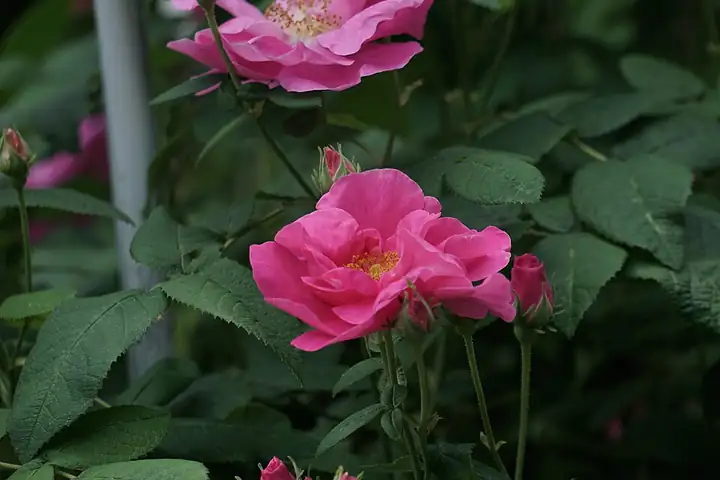
Apothecary rose
Rosa gallica 'Officinalis' · Rose family (Rosaceae)
When to plant: Plant bare-root roses while dormant: in spring where winters drop below -10°F, and in fall or spring elsewhere.
| Hardiness zones | 4 to 9 |
|---|---|
| Sun | full sun |
| Water | moderate |
| Life cycle | perennial |
| Frost | Hardy: takes frost |
| Spacing | 36 to 72 inches |
About Apothecary rose
The apothecary rose is one of the oldest garden roses, a compact gallica shrub long valued for perfume and medicine and known as the red rose of Lancaster. It blooms once a year in late spring with highly scented flowers, spreads by suckers, and forms hips if the flowers are left on.
NC State lists zones 4-9 for 'Rosa Mundi', a striped sport of the apothecary rose; Illinois Extension calls gallica roses extremely cold-hardy.
When to plant
Plant bare-root roses while dormant: in spring where winters drop below -10°F, and in fall or spring elsewhere.
Container roses can go in any time during the growing season (University of Missouri Extension).
Soil
Well-drained soil with some organic matter; gallicas tolerate soil that is not especially fertile.
Mix 2-4 inches of aged manure, peat moss or leaf compost into the planting area; gallica roses tolerate soil that is not overly fertile, and the site must drain well.
Feeding
- every 4-6 weeks during the growing season, once the plant is established: all-purpose fertilizer such as 8-10-8. Scatter it around the plant at the label rate and water it in; stop feeding by August 15 (Colorado State).
Look for: a balanced or all-purpose fertilizer at the label rate. Skip high-phosphorus "bloom boosters" unless a soil test shows low phosphorus: most garden soils already have enough, and the extra can wash into streams.
Feeding after mid-August pushes soft new growth that frost can injure.
Harvest
Blooms once, about May to June. Pick petals from unsprayed plants as the flowers open; leave some flowers to form orange hips, and pick hips when firm and red, often after the first frost.
Varieties (16)
| Variety | Type | Season and days | Zones | Notes |
|---|---|---|---|---|
| Celsiana | Damask | 4–9typical for apothecary rose | Pink flowers on a rather loose, open shrub. Painted by the famous rose artist Redouté. Sources: [12] | |
| Ispahan | Damask | Summer, light repeat in fall | 4–9typical for apothecary rose | Robust, bushy shrub about 3-5 ft tall with clusters of full, pale to mid-pink fragrant flowers about 3 in. across. Blooms in summer with a few more flowers in fall. Holds the RHS Award of Garden Merit. Sources: [13] |
| Madame Hardy | Damask | Once a year, midsummer | 4–9typical for apothecary rose | Vigorous, prickly shrub about 3-5 ft tall. Pure white, fully double, quartered flowers about 4 in. across with a green button eye and a strong scent. Raised in 1832. Holds the RHS Award of Garden Merit. Sources: [12][14] |
| Madame Zoëtmans | Damask | 4–9typical for apothecary rose | A damask rose small enough for small gardens. Sources: [12] | |
| Kazanlik | Damask (also called 'Trigintipetala') | Once a year, midsummer | 4–9typical for apothecary rose | Vigorous shrub about 3-5 ft tall and wide with loose, shaggy, semi-double warm pink flowers and a very strong scent. The classic damask rose grown for rose oil for centuries. Sources: [15] |
| Assemblage des Beautés | Gallica | Once a year, early summer | 4–9typical for apothecary rose | Compact bush with vivid cerise-crimson flowers. Sources: [12] |
| Belle de Crécy | Gallica | Once a year, early summer | 4–9typical for apothecary rose | Well-scented flowers that open warm cerise and fade to soft lilac-gray. Reasonably sturdy. Sources: [12] |
| Du Maître d'École | Gallica | Once a year, early summer | 4–9typical for apothecary rose | Very full, double flowers, among the largest of the gallicas, cerise-pink fading to lilac and gray, with a good scent. Short and sturdy, seldom over about 3 ft. Sources: [12] |
| Duc de Guiche | Gallica | Once a year, early summer | 4–9typical for apothecary rose | Compact bush with strong magenta-tinted flowers. Sources: [12] |
| Gloire de France | Gallica | Once a year, early summer | 4–9typical for apothecary rose | Fragrant flowers with gray and lilac tints. Sources: [12] |
| Président de Sèze | Gallica | Once a year, early summer | 4–9typical for apothecary rose | Fragrant flowers with gray and lilac tints. Sources: [12] |
| Surpasse Tout | Gallica | Once a year, early summer | 4–9typical for apothecary rose | Compact bush with strong magenta-tinted flowers. Sources: [12] |
| Tricolore de Flandre | Gallica | Once a year, early summer | 4–9typical for apothecary rose | Loosely double flowers with dark mulberry and gray tints. More vigorous than 'Camaieux'. Sources: [12] |
| Tuscany Superb | Gallica | Once a year, early summer | 4–9typical for apothecary rose | A gallica that spreads by wandering roots, so it can sucker into a patch. Sources: [12] |
| Versicolor (Rosa Mundi) | Gallica | Once a year, early summer | 4–9typical for apothecary rose | Compact shrub about 3 ft tall and wide. Fragrant semi-double flowers striped rose-red and white; some come solid red. A striped sport of 'Officinalis' and may revert to it. Holds the RHS Award of Garden Merit. Sources: [12][16] |
| Officinalis | Gallica (the apothecary's rose) | Once a year, early summer | 4–9typical for apothecary rose | Compact shrub about 3 ft tall and wide. Semi-double, rosy-crimson flowers about 3 in. across with gold stamens and a strong scent. Tolerates poor soil. Grown since at least the 1300s. Also called the red rose of Lancaster. Holds the RHS Award of Garden Merit. Sources: [12][17] |
Pests to watch for
Japanese beetle, Rose chafer, Aphids, Deer, Rose sawflies (roseslugs), Rose midge
Diseases and problems
Black spot, Powdery mildew, Rust, Rose rosette, Rose mosaic
In the kitchen
Rose petals are edible in salads, tea and jelly, and rose hips make tea, jam and jelly and are very high in vitamin C (Illinois Extension, University of Alaska Fairbanks).
Keeping it: Use petals the day you pick them. Fresh hips keep a few days in the fridge; seed and dry or freeze them for longer storage.
Safety: Never eat roses treated with pesticides, and remove the seeds and hairs from hips before use; University of Alaska Fairbanks warns the seeds can cause problems in the gut. The European Medicines Agency does not recommend rose-petal remedies in pregnancy, while breastfeeding or for children under 12 because safety data are lacking.
Pets: Non-toxic to dogs, cats and horses (ASPCA, rose, Rosa species)
Sources
- plants.ces.ncsu.edu
- extension.illinois.edu
- extension.missouri.edu
- planttalk.colostate.edu
- extension.illinois.edu
- uaf.edu
- extension.umn.edu
- cues.cfans.umn.edu
- ema.europa.eu
- invasiveplantatlas.org
- aspca.org
- historicroses.org
- rhs.org.uk
- rhs.org.uk
- rhs.org.uk
- rhs.org.uk
- rhs.org.uk
Photo: Photo: 掬茶 / Wikimedia Commons, CC BY-SA 4.0 (CC BY-SA 4.0). Photo resized for the web.

Planting dates and advice are general guidance; check with your local Cooperative Extension office for your area.