
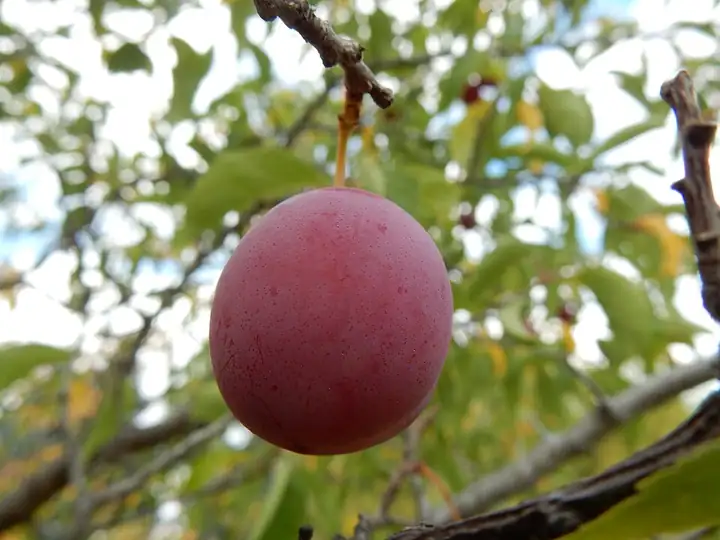
American plum (wild plum)
Prunus americana · Rose family (Rosaceae)
When to plant: Plant dormant bare-root trees in early spring once the ground can be worked (University of Minnesota, for stone fruits); NRCS plantings set them 8 feet apart in rows 16 feet apart.
| Hardiness zones | 3 to 9 |
|---|---|
| Sun | full sun to part shade |
| Water | low |
| Life cycle | perennial |
| Frost | Hardy: takes frost |
| Spacing | 96 inches |
About American plum (wild plum)
American plum is a native small tree or thicket-forming shrub with fragrant white spring flowers and small red to purple plums in late summer. The fruit is best in jelly, jam and sauce. It is hardy and drought-tolerant, and it makes a good pollen partner for cold-hardy hybrid plums.
NC State lists zones 3-9. It grows wild from Massachusetts to Manitoba and Montana, south to Utah, Colorado, Oklahoma and Florida (USDA NRCS).
When to plant
Plant dormant bare-root trees in early spring once the ground can be worked (University of Minnesota, for stone fruits); NRCS plantings set them 8 feet apart in rows 16 feet apart.
Under good conditions they flower and fruit within 3 years (USDA NRCS), and they sucker freely into thickets (NC State).
Soil
Well-drained soil is best, but it tolerates sandy to poorly drained soils, heat and drought (USDA NRCS; NC State).
Plant in well-drained soil in a sunny spot for the best fruit, keeping weeds down around young trees.
Feeding
- Each spring once established, only if growth is weak: compost (a nitrogen source). Skip feeding if last season's shoots grew 15 inches or more; bearing trees should make at least about 8 inches of new growth (University of Minnesota, for stone fruits).
Look for: mostly nitrogen, in spring as growth starts. Spring feeding grows the new shoots and leaves that carry flowers and fruit; feeding after midsummer pushes soft growth that may not harden before winter.
Don't overfeed a tree that is growing well; plant more than one American plum, since it is cross-pollinated.
Harvest
Fruit ripens from August to September (USDA NRCS), or July-August in North Carolina (NC State), turning red to dark purple. As with other plums, ripe flesh gives to gentle thumb pressure, and tasting is the best test (University of Minnesota).
American plum fruits every year: it flowers in April-May and the plums ripen in August-September.
Varieties (19)
| Variety | Type | Season and days | Notes |
|---|---|---|---|
| Blackhawk | American plum selection | USDA NRCS names it as a cultivar descended from wild American plum; no source we opened describes the fruit. Sources: [1][2] | |
| De Soto | American plum selection | USDA NRCS names it as a cultivar descended from wild American plum; no source we opened describes the fruit. Also written Desoto. Sources: [1][2] | |
| Hawkeye | American plum selection | USDA NRCS names it as a cultivar descended from wild American plum; no source we opened describes the fruit. Sources: [1][2] | |
| South Dakota | American plum type | September | Medium plums with reddish-yellow skin, good fresh or in preserves. Hardy, vigorous and productive. Nebraska lists it for zones 4-5. Needs another plum nearby for pollination. Sources: [8] |
| Alderman | Hybrid (Japanese x American plum) | Mid-August | Large, sweet, juicy fruit with burgundy skin and golden flesh. Attractive tree to about 20 ft. Minnesota rates it good in zone 4 and fair in zone 3. Thin the fruit for bigger plums. University of Minnesota release (1986). Pollinize with Superior, Toka or a wild plum. Sources: [4][9] |
| BlackIce | Hybrid (Japanese x American plum) | Late July to early August | Large, 2-inch plums with blue-black skin and deep red flesh. Naturally small, weeping tree to about 10 ft. Rated very good in zone 4 and good in zone 3 (Minnesota). Not self-fruitful: plant Toka or a wild American plum nearby for pollen. Sources: [4] |
| Ember | Hybrid (Japanese x American plum) | Utah State lists it among cold-hardy hybrid plums for zones 3-4 but gives no other details. Sources: [9] | |
| Kaga | Hybrid (Japanese x American plum) | Utah State calls it an especially popular pollinator for other hybrid plums and notes it is also sold as Bubblegum. Sources: [9] | |
| LaCrescent | Hybrid (Japanese x American plum) | Late July to early August | Small to medium yellow plums, juicy and very sweet with a hint of apricot. Tree to about 15 ft; rated very good in zone 4 and good in zone 3 (Minnesota). University of Minnesota release (1923). Pollinize with Toka or a wild plum; Superior will not work. Also written La Crescent. Sources: [4][9] |
| Monitor | Hybrid (Japanese x American plum) | Utah State lists it among cold-hardy hybrid plums for zones 3-4 but gives no other details. Sources: [9] | |
| Pembina | Hybrid (Japanese x American plum) | Mid- to late August | Large, pointed plums with bright red skin and sweet, juicy yellow flesh. Extremely hardy tree to about 15 ft; Minnesota says it may even survive zone 2. Introduced in South Dakota (1923). Not self-fruitful: plant Toka or a wild American plum nearby for pollen. Sources: [4] |
| Pipestone | Hybrid (Japanese x American plum) | Mid-August | Very large plums with thin, tough red skin and sweet, melting golden flesh. Tree to about 15 ft. Minnesota rates it very good in zone 4 and good in zone 3. University of Minnesota release (1942). Not self-fruitful: plant Toka or a wild American plum nearby for pollen. Sources: [4][9] |
| Redglow | Hybrid (Japanese x American plum) | Utah State lists it among cold-hardy hybrid plums for zones 3-4 but gives no other details. Sources: [9] | |
| Superior | Hybrid (Japanese x American plum) | Mid-August | Large plums with bright red, peelable skin and rich, very sweet yellow flesh. Very hardy, fast-growing tree to about 15 ft. Minnesota rates it good in zone 4 but poor in zone 3; Nebraska lists zones 4-5. University of Minnesota release (1933). Pollinize with Alderman, Toka or a wild plum; LaCrescent will not work. Sources: [4][8][9] |
| Tecumseh | Hybrid (Japanese x American plum) | Utah State lists it among cold-hardy hybrid plums for zones 3-4 but gives no other details. Sources: [9] | |
| Toka | Hybrid (Japanese x American plum) | Mid- to late August | Medium, richly flavored fruit with deep magenta to apricot-colored skin, golden flesh and a spicy-sweet taste. Very hardy tree to about 20 ft. Minnesota rates it good in zone 4 and fair in zone 3. The standard pollen tree for other hybrid plums. Utah State lists it as Toga, a good pollinator. Sources: [4][8][9] |
| Underwood | Hybrid (Japanese x American plum) | Mid- to late July | Medium, heart-shaped plums with red skin and soft yellow flesh. Very hardy tree to about 15 ft; rated very good in zone 4 and good in zone 3 (Minnesota). One of the oldest University of Minnesota plums (1920). Not self-fruitful: plant Toka or a wild American plum nearby for pollen. Sources: [4][9] |
| Waneta | Hybrid (Japanese x American plum) | Late July to early August | Red skin over sweet, juicy yellow flesh. Very hardy tree to about 15 ft; rated very good in zone 4 and good in zone 3 (Minnesota). Developed in South Dakota (1913). Not self-fruitful: plant Toka or a wild American plum nearby for pollen. Sources: [4][9] |
| Midwest Premium | Native germplasm release (conservation) | A blend of six wild American plum collections rather than a single clone. Released by the USDA NRCS Elsberry, Missouri, Plant Materials Center from wild plants collected in Missouri, Illinois and South Dakota. Sources: [1][10] |
Good neighbors
American plum is cross-pollinated, so plant more than one (USDA NRCS). It is also a pollen source for hybrid plums such as Alderman, Pipestone, Superior, Toka and Underwood (University of Minnesota).
Pests to watch for
Plum curculio, Aphids, Scale insects, Eastern tent caterpillar, Deer, Rabbits
Diseases and problems
Brown rot, Black knot, Leaf spot, Canker, Plum pockets
In the kitchen
Eaten fresh or made into sauce, jam and jelly, canned or baked (USDA NRCS); the raw fruit is often tart, so it is best in preserves (NC State).
Keeping it: Ripe plums keep in the refrigerator for a few days; let firmer ones finish ripening at room temperature in a paper bag first.
Safety: Seeds, leaves and stems contain cyanide-forming compounds. Swallowing a couple of whole pits by accident won't poison you, but crushing or chewing them raises the danger (NC State).
Pets: Toxic to dogs, cats and horses (ASPCA lists plums and cherries, Prunus spp.): stems, leaves and seeds contain cyanogenic glycosides, especially as leaves wilt; signs include brick-red gums, dilated pupils, trouble breathing, panting and shock
Sources
- nrcs.usda.gov
- plants.sc.egov.usda.gov
- plants.ces.ncsu.edu
- extension.umn.edu
- plantsservices.sc.egov.usda.gov
- aspca.org
- aspca.org
- extensionpubs.unl.edu
- extension.usu.edu
- npgsweb.ars-grin.gov
Photo: Photo: Matt Lavin / Wikimedia Commons, CC BY-SA 2.0 (CC BY-SA 2.0). Photo resized for the web.

Planting dates and advice are general guidance; check with your local Cooperative Extension office for your area.