
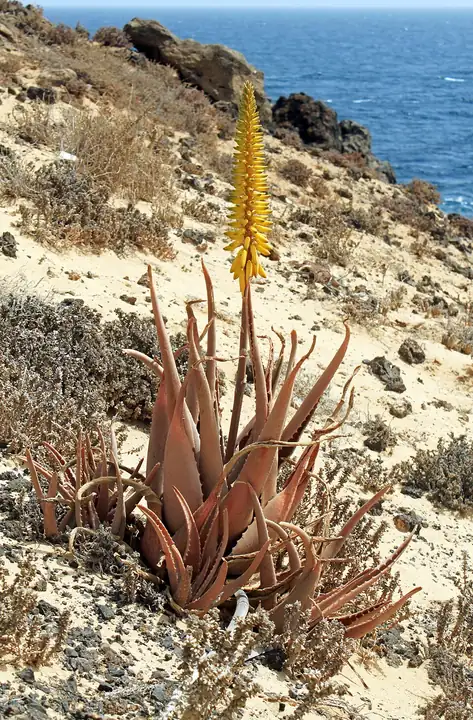
Aloe vera
Aloe vera (formerly Aloe barbadensis) · Asphodel family (Asphodelaceae)
When to plant: Any time of year, since it grows indoors. Repot about every 2 years, and pot up the pups around the base to start new plants.
| Hardiness zones | 10 to 12 |
|---|---|
| Sun | full sun to part shade |
| Water | low |
| Life cycle | perennial |
| Frost | Tender: killed by frost |
Will it grow in your window?
Pick the window it sits in. This is the same check Sow & Tell runs for every plant in your house.
It wants bright, direct light.
Pick a window above and this will tell you whether the spot suits it.
Watering: soak it, then let it dry right out — about every 14 days, stretching to every 28 from November to February.
Summering outside? Bring it in before nights drop below 55°F.
About Aloe vera
Aloe vera is a stemless succulent from the Arabian Peninsula with a rosette of thick, gray-green leaves edged in small white teeth and filled with a clear gel (NC State). It is one of the easiest windowsill plants, asking only for sun and a fast-draining pot, and people keep it close to the kitchen for the gel, which has been used on cuts and sunburn for centuries. Mature plants send up a spike of tubular yellow, orange or red flowers, mostly outdoors in zones 10 and warmer.
Hardy outdoors only in zones 10-12 (NC State); it is grown indoors everywhere and can summer outdoors in part sun once nights stay above about 55 F, moved out gradually so the leaves don't scorch (NC State, MU Extension).
When to plant
Any time of year, since it grows indoors. Repot about every 2 years, and pot up the pups around the base to start new plants.
Usually bought as a small nursery plant or started from an offset (pup) separated from a mature plant (Penn State, NC State).
Growing it indoors
- Light: Needs at least 6 hours of sun, so give it a south or west window; in dim light it stretches and pales, and a plant moved straight into summer sun scorches, so acclimate it over a week or two (NC State, Iowa State).
- Water: Water thoroughly when the soil has dried completely, let the excess drain, and then leave it alone; in fall and winter cut back so the mix stays barely moist and the leaves don't shrivel (NC State, Penn State). Sitting in water rots the roots, which is the main way aloes die, so use a pot with large drainage holes and err on the dry side.
- Humidity: Dry room air suits it; low humidity is normal and good for succulents, so skip misting (Iowa State).
- Temperature: MU Extension lists 55 F as its night temperature; it is not frost tolerant, so bring it in before frost and keep it off cold windowsills (Penn State).
- Feeding: Iowa State feeds succulents an all-purpose or succulent fertilizer at a quarter to half the label rate every 3-4 waterings in spring and summer, or one dose of slow-release early in the season, and none in winter.
- Repotting: Every 2 years, into a pot about 1-1.5 inches wider than the root ball with the leaves just above the soil line (Penn State).
- More plants: Separate the offsets (pups) that form around the mother plant and pot each in its own small pot of succulent mix (Penn State, NC State); division is the usual method.
If something looks wrong
| What you see | Likely cause | What to do |
|---|---|---|
| Soft, mushy, yellowing leaves and wet mix | Overwatering or a pot with no drainage | Stop watering until the mix is fully dry, check the drainage hole, and repot in fresh succulent mix if the roots are brown and mushy (Iowa State, Penn State). |
| Pale, stretched, floppy leaves | Too little light | Move it to a south or west window or add a grow light 12 inches away for 12-16 hours a day (Iowa State, NC State). |
| Brown or tan patches on the leaves after a move outdoors | Sunscald from a sudden jump to direct sun | Shade it from hot afternoon sun and move it into brighter light gradually; the scarred tissue won't recover (Iowa State). |
| White cottony tufts or brown bumps between the leaves | Mealybugs or scale | Wipe them off with a cotton swab dipped in rubbing alcohol and repeat weekly; NC State lists mealybugs, aphids and scale as its pests. |
Soil
A coarse cactus-and-succulent mix, or one part potting soil, one part sand and one part perlite, in a clay pot with several drainage holes (NC State, Penn State).
Pot in a coarse cactus-and-succulent mix (or equal parts potting soil, sand and perlite) in a clay pot with several drainage holes (NC State, Penn State).
Feeding
- Spring and summer, while new leaves are coming: all-purpose or succulent fertilizer at a quarter to half the label rate. Water first, then feed every 3rd or 4th watering, or apply one dose of slow-release fertilizer early in the season (Iowa State); MU Extension says monthly for any houseplant that is growing.
- Fall and winter: none. Skip feeding while the plant rests and the mix stays nearly dry (Iowa State, MU Extension).
Too much fertilizer gives soft, weak growth that rots easily, and a wet pot kills far more aloes than a lean one (Illinois Extension, Penn State).
Varieties (2)
NC State's aloe page names only 2 small hybrid cultivars; Aloe vera itself is sold as the straight species.
| Variety | Type | Zones | Notes |
|---|---|---|---|
| Delta Lights | Small hybrid aloe | 10+typical for aloe vera | A compact hybrid with wide gray leaves striped in white; the stripes can flush pink in bright light. An ornamental aloe, not a source of gel. Sources: [2] |
| Minnie Belle | Small hybrid aloe | 10+typical for aloe vera | Dark green rosettes of spotted, lance-shaped leaves with white teeth. An ornamental aloe, not a source of gel. Sources: [2] |
Pests to watch for
Diseases and problems
Root and crown rot, Leaf spot, Sooty mold
In the kitchen
NC State: the clear inner gel has been used on the skin for centuries for cuts, sunburn and other skin problems; cut away the outer part of the leaf, use only the gel, and test a small patch of skin first. NCCIH: topical aloe gel is generally well tolerated and may speed burn healing, but the yellow latex just under the leaf skin is a laxative that causes cramps and diarrhea (the FDA ordered it out of over-the-counter laxatives in 2002), oral leaf extracts have been linked to cases of hepatitis and untreated whole-leaf extract to gut tumors in rats and mice, and oral aloe may be unsafe in pregnancy and breastfeeding, so don't eat or drink home-prepared aloe.
Safety: NC State rates it low severity: the leaves contain an anthraquinone glycoside, and eating them causes abdominal cramping, diarrhea and red urine, while the latex can irritate skin (contact dermatitis). NCCIH adds that aloe latex overuse may raise the risk of side effects from heart drugs such as digoxin, that oral aloe may be unsafe during pregnancy and breastfeeding, and that untreated (non-decolorized) whole-leaf extract is classified as a possible human carcinogen; the ASPCA lists aloe as toxic to dogs and cats.
Pets: Toxic to dogs, cats and horses (ASPCA): saponins and anthraquinones cause vomiting (not in horses), lethargy and diarrhea. The ASPCA notes the gel itself is considered safe to eat; it is the latex in the rest of the leaf that does the harm.
Sources
- plants.ces.ncsu.edu
- plants.ces.ncsu.edu
- extension.psu.edu
- extension.missouri.edu
- yardandgarden.extension.iastate.edu
- yardandgarden.extension.iastate.edu
- nccih.nih.gov
- aspca.org
- extension.illinois.edu
Photo: Photo: H. Zell, CC BY-SA 3.0, via Wikimedia Commons (CC BY-SA 3.0). Photo resized for the web.

Planting dates and advice are general guidance; check with your local Cooperative Extension office for your area.