
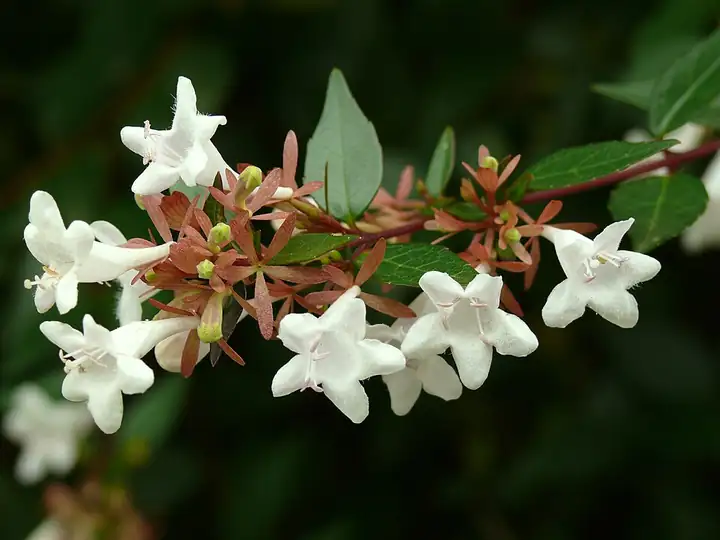
Glossy abelia
Abelia x grandiflora · Honeysuckle family (Caprifoliaceae)
| Hardiness zones | 6 to 9 |
|---|---|
| Sun | full sun to part shade |
| Water | moderate |
| Life cycle | perennial |
| Frost | Hardy: takes frost |
About Glossy abelia
Glossy abelia is a dense, rounded shrub with shiny leaves and small white-to-pink bell flowers from late spring until fall. Bees, butterflies and hummingbirds visit it, and pink sepals hang on after the petals drop. Many compact and colorful-leaf cultivars exist, and it rarely has pest problems.
Zones 6-9; semi-evergreen in the South, and in zones 6-7 a hard winter can kill it back to the ground.
Planting
Plant in a sheltered spot in colder zones. Flowers best in full sun; drought tolerant once established.
Soil
Moist, well-drained loam, clay or sand; acid to alkaline pH. It dislikes salty soil.
Loosen the soil and work in compost; follow a soil test before adding fertilizer.
Feeding
- Established plants: spring as growth begins (a split feeding can follow in early summer): Slow-release shrub fertilizer, about 3-1-1 or 3-1-2 ratio (3-0-1 if the soil test shows enough phosphorus). Follow a soil test. Spread it evenly over the root zone and water it in; for slow-release types Clemson's upper limit is 2-4 lb of nitrogen per 1,000 sq ft per year.
Look for: a balanced or all-purpose fertilizer at the label rate. Skip high-phosphorus "bloom boosters" unless a soil test shows low phosphorus: most garden soils already have enough, and the extra can wash into streams.
Abelia needs very little care once established; heavy feeding isn't needed.
Harvest
Blooms late spring to fall, heaviest in June-July, on new growth. Prune in late winter or early spring; it rarely needs more.
Varieties (16)
| Variety | Zones | Notes |
|---|---|---|
| Canyon Creek | 6–9typical for glossy abelia | Coppery-pink new leaves turning yellow-green; light pink flowers; 4-6 ft. Sources: [1][2] |
| Confetti | 6–9typical for glossy abelia | Cream-variegated leaves that take on red tones in cool weather. Sources: [1][2] |
| Edward Goucher | 6–9typical for glossy abelia | Compact, 3-5 ft, with lavender-pink flowers. Sources: [1][2] |
| Francis Mason | 6–9typical for glossy abelia | Yellow-green leaves and pink flowers. Sources: [1] |
| Hopleys | 6–9typical for glossy abelia | Compact with variegated leaves and white flowers. Sources: [1] |
| Kaleidoscope | 6–9typical for glossy abelia | Leaves change through many colors; white flowers. Sources: [1][2] |
| Little Richard | 6–9typical for glossy abelia | Compact to about 3 ft; bright red new leaves, white flowers, pink fall color. Sources: [1] |
| Mardi Gras | 6–9typical for glossy abelia | Creamy-white and green variegated leaves, pink-tinted new growth, red stems. Sources: [1] |
| Prostrata | 6–9typical for glossy abelia | Low, spreading form with white flowers. Sources: [1] |
| Radiance | 6–9typical for glossy abelia | Bright variegated leaves and vivid red stems. Sources: [1] |
| Rose Creek | 6–9typical for glossy abelia | Leaves turn purple-green in winter. Sources: [1][2] |
| Ruby Anniversary | 6–9typical for glossy abelia | Reddish leaves in spring and fall; white flowers. Sources: [1] |
| Sherwoodii | 6–9typical for glossy abelia | Dwarf to about 3 ft with small leaves and flowers. Sources: [1][2] |
| Silver Anniversary | 6–9typical for glossy abelia | Fragrant pinkish-white flowers. Sources: [1] |
| Sunrise | 6–9typical for glossy abelia | Green, yellow and cream variegated leaves; tends to revert to green. Sources: [1][2] |
| Sunshine Daydream | 6–9typical for glossy abelia | Compact with three-color leaves and fragrant flowers. Sources: [1] |
Pests to watch for
In the kitchen
Pets: Not listed as toxic by the ASPCA (no abelia entry)
Sources
Photo: Photo: Mariko GODA, Public domain, via Wikimedia Commons. Photo resized for the web.

Planting dates and advice are general guidance; check with your local Cooperative Extension office for your area.