
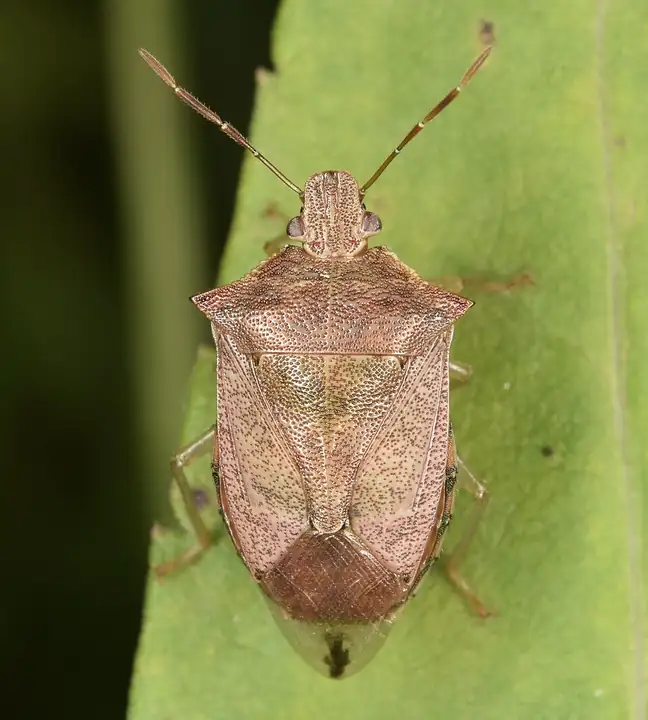
Spined soldier bug
Podisus maculiventris (a predatory stink bug, family Pentatomidae)
| Type | Insect |
|---|---|
| What it does | Predator |
| When | Spring through fall; adults spend winter under bark or in leaf litter. |
| How common it is by region | Very common here: Northeast, Southeast, South Central, Midwest, Great Plains |
About
The spined soldier bug is a stink bug that eats other insects instead of plants, and it is found across the continental United States. It hunts caterpillars and beetle larvae, including Mexican bean beetle and Colorado potato beetle grubs.
This one is already on your side. Broad sprays kill it along with the pest, which is why the guide puts sprays last.
What it eats
More than 100 kinds of insects, mostly young ones: caterpillars such as cabbage loopers, imported cabbageworms, armyworms, corn earworms and European corn borers, beetle larvae such as Mexican bean beetles, Colorado potato beetles and flea beetles, and plant-feeding stink bugs. It may sip a little plant juice when prey is scarce.
Pests it goes after
Beet armyworm, Cabbage looper, Colorado potato beetle, Corn earworm (tomato fruitworm), Diamondback moth, European corn borer, Fall armyworm, Flea beetles, Imported cabbageworm, Mexican bean beetle, Stink bugs
Spotting it
How to find it early
A tan to pale brown shield-shaped bug about two-fifths of an inch long, with sharp spines sticking out at the shoulders and a dark line on each wing tip. Look on beans, potatoes, cabbage-family crops and tomatoes where caterpillars or beetle larvae are feeding.
Its young
Young nymphs are round and wingless, with a black head and a red-and-black body; older ones are banded red, black, yellow-orange and cream. Eggs are tiny gray, cream or gold barrels in clusters of 20 to 30, ringed with little spines on top.
When
Spring through fall; adults spend winter under bark or in leaf litter.
Easy to mistake for
- Stink bugs — The spined soldier bug has sharply pointed shoulders and holds its beak straight out in front to stab prey, while plant-feeding stink bugs have rounder shoulders and point the beak down into the plant.
Bringing more of them in
Don't spray stink-bug-shaped insects without a close look, avoid broad-spectrum insecticides, and keep flowering plants nearby for nectar and pollen.
Buying it
It is sold, but Cornell notes releases have not been proven to control Mexican bean beetle in large trials.
How common it is by region
| Northeast | Very common here |
|---|---|
| Southeast | Very common here |
| South Central | Very common here |
| Midwest | Very common here |
| Great Plains | Very common here |
| Mountain West | Common here |
| Southwest | Common here |
| Pacific Northwest | Common here |
| California | Common here |
| Alaska | Occasional here |
| Hawaii | Occasional here |
Sources
Photo: Photo: Christina Butler / Wikimedia Commons, CC BY 2.0 (CC BY 2.0). Photo resized for the web.

Planting dates and advice are general guidance; check with your local Cooperative Extension office for your area.