
Snakeflies
Order Raphidioptera (families Raphidiidae and Inocelliidae), such as Agulla species; in North America found only in the West
| Type | Insect |
|---|---|
| What it does | Predator |
| When | Adults can be seen spring through fall; larvae spend winter under bark. |
| How common it is by region | Common here: Mountain West, Pacific Northwest, California |
About
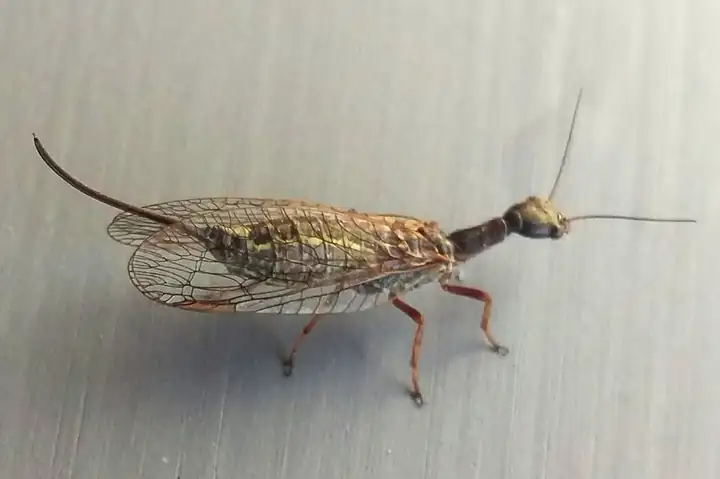
Snakeflies are slim, lacewing-like insects with a long 'neck' that lets them lift their head like a snake about to strike. Both the adults and the larvae hunt small, soft-bodied insects on trees and shrubs in western gardens and orchards.
This one is already on your side. Broad sprays kill it along with the pest, which is why the guide puts sprays last.
What it eats
Aphids, mites, small caterpillars, insect eggs and other soft prey; WSU also lists leafhoppers, whiteflies, thrips, mealybugs and scales. In pear orchards the adults are important early-season predators of pear psylla, and UC says they may help against Asian citrus psyllid.
Pests it goes after
Aphids, Asian citrus psyllid, Mealybugs, Pear psylla, Scale insects, Thrips, Twospotted spider mite, Whiteflies
Spotting it
How to find it early
Look on the leaves and branches of fruit trees and shrubs for a 3/4-inch insect with four clear, veined wings held like a roof and an extra-long neck. Females have a long, thin tail that is an egg-laying tube.
Its young
Larvae are long, flat and mottled reddish or gray, with a shiny black head and front segment, and live under tree bark or in leaf litter. They take two to three years to grow up, so leave loose bark alone.
When
Adults can be seen spring through fall; larvae spend winter under bark.
Easy to mistake for
- Green lacewings — Snakeflies have similar lacy wings held like a roof, but a long, raised neck and long head; lacewings have a short neck.
- Brown lacewings — Brown lacewings are small and brown with a short neck, while snakeflies have a stretched-out neck and, in females, a long egg-laying tail.
Bringing more of them in
Keep some trees, shrubs and native plants, leave bark and leaf litter in place, and avoid regular broad-spectrum insecticide sprays.
How common it is by region
| Northeast | Not found here |
|---|---|
| Southeast | Not found here |
| South Central | Occasional here |
| Midwest | Not found here |
| Great Plains | Occasional here |
| Mountain West | Common here |
| Southwest | Occasional here |
| Pacific Northwest | Common here |
| California | Common here |
| Alaska | Not found here |
| Hawaii | Not found here |
Sources
Photo: Photo: Saillwhite / Wikimedia Commons, CC BY-SA 4.0 (CC BY-SA 4.0). Photo resized for the web.

Planting dates and advice are general guidance; check with your local Cooperative Extension office for your area.