
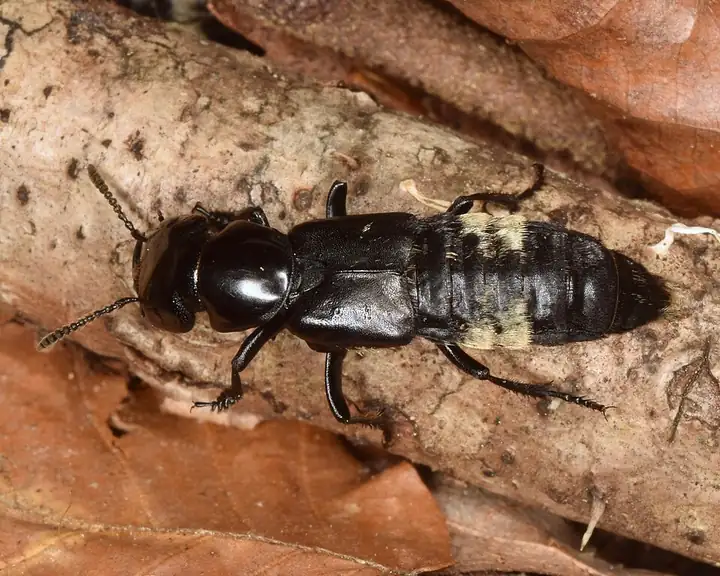
Rove beetles
Family Staphylinidae, one of the largest beetle families; garden helpers include Aleochara bilineata, which attacks cabbage maggots, and tiny spider-mite-eating Oligota species
| Type | Insect |
|---|---|
| What it does | Predator, Parasitoid |
| How common it is by region | Very common here: Northeast, Southeast, South Central, Midwest, Great Plains, Mountain West, Southwest, Pacific Northwest, California |
About
Rove beetles are slender beetles with short wing covers that leave most of the abdomen bare, so they look a lot like earwigs without the tail pincers. Most hunt small insects, eggs and mites in the soil and mulch, and some attack root maggots.
This one is already on your side. Broad sprays kill it along with the pest, which is why the guide puts sprays last.
What it eats
Root maggot eggs and larvae, mites, springtails, insect eggs and other tiny soil animals. Aleochara bilineata adults eat cabbage maggot eggs and young maggots, and its larvae live as parasites inside the maggots' pupae; tiny Oligota beetles eat spider mites.
Pests it goes after
Aphids, Cabbage maggot, Onion maggot, Twospotted spider mite
Spotting it
How to find it early
Narrow black or brown beetles, many a quarter inch or smaller, that run quickly and curl the tip of the abdomen up like a tiny scorpion when disturbed. Look in moist mulch, compost piles, under stones and boards, and in the soil of vegetable beds.
Its young
Larvae are slim, segmented and active, often with sharp jaws, and are easily taken for ground beetle larvae; they stay in soil, compost and leaf litter.
When
Spring through fall; Aleochara adults show up in late spring, so they help more with later root maggot generations.
Easy to mistake for
- European earwig — Earwigs have a pair of movable pincers at the tail end; rove beetles have none.
Bringing more of them in
Keep some moist organic matter around, like mulch, compost and leaf litter, and avoid soil insecticides in root crop beds.
Buying it
Not sold for outdoor garden pest control in North America; a few species are sold for greenhouse use.
Worth knowing
Don't crush a rove beetle on bare skin: a few kinds (Paederus) carry a fluid that blisters skin. Brush it off instead, and wash the spot if one gets crushed.
How common it is by region
| Northeast | Very common here |
|---|---|
| Southeast | Very common here |
| South Central | Very common here |
| Midwest | Very common here |
| Great Plains | Very common here |
| Mountain West | Very common here |
| Southwest | Very common here |
| Pacific Northwest | Very common here |
| California | Very common here |
| Alaska | Common here |
| Hawaii | Common here |
Sources
Photo: Photo: Christina Butler / Wikimedia Commons, CC BY 2.0 (CC BY 2.0). Photo resized for the web.

Planting dates and advice are general guidance; check with your local Cooperative Extension office for your area.