
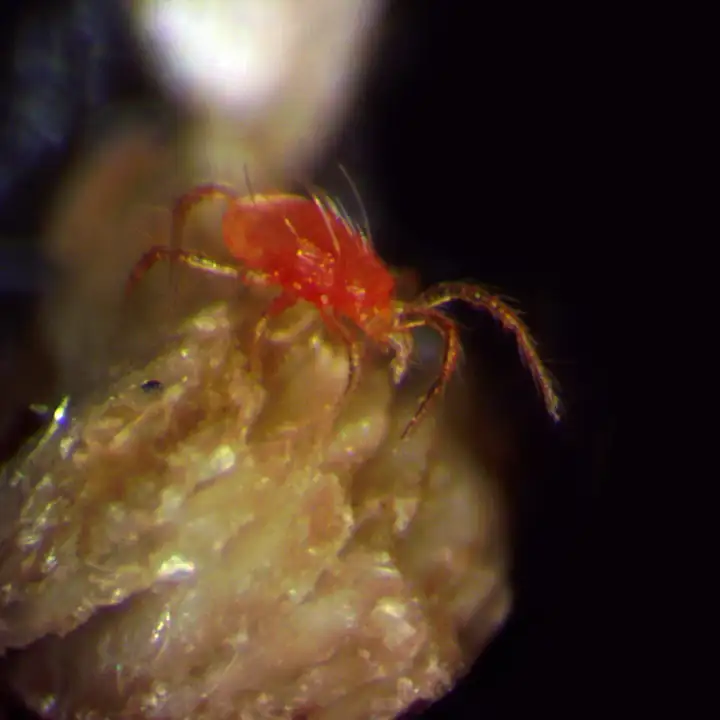
Predatory mites
Family Phytoseiidae; common ones include Phytoseiulus persimilis, the western predatory mite (Galendromus occidentalis), Neoseiulus fallacis, N. cucumeris and N. californicus
| Type | Mite |
|---|---|
| What it does | Predator |
| How common it is by region | Common here: all regions |
About
Predatory mites are tiny, fast-moving mites that hunt the spider mites, broad mites and thrips that damage garden plants. They are about the size of a spider mite, so they're easy to overlook, but they can keep mite outbreaks in check when sprays don't kill them off.
This one is already on your side. Broad sprays kill it along with the pest, which is why the guide puts sprays last.
What it eats
Spider mites in all stages, especially their eggs and young, plus European red mite, broad mite, cyclamen mite and rust mites; some kinds, like Neoseiulus cucumeris, also eat young thrips, whiteflies and potato psyllids. Many survive on pollen when prey is scarce.
Pests it goes after
Broad mite, Cyclamen mite, European red mite, Potato psyllid (tomato psyllid), Thrips, Twospotted spider mite, Whiteflies
Spotting it
How to find it early
With a hand lens, look for pear-shaped, shiny mites about a fiftieth of an inch long, tan, cream, orange or reddish, racing around on leaf undersides among slower spider mites. They have no dark side spots.
Its young
Eggs are oval, clear to cream or pale orange, and a bit bigger and more oblong than round spider mite eggs; the young are pale and see-through.
When
Spring through fall outdoors; year-round in greenhouses and mild climates. In cold areas mated females spend winter in bark and leaf litter.
Easy to mistake for
- Twospotted spider mite — Twospotted spider mites have a dark blotch on each side, are wider at the front, and move slowly; predatory mites have no spots, are wider at the rear, look shinier, and run fast.
Bringing more of them in
Avoid broad-spectrum insecticides and harsh miticides, which kill them faster than spider mites, and hose dust off plants. Leave some leaf litter and bark for winter shelter, and don't wipe out every last spider mite, since they need food.
Buying it
Several kinds are sold and work in greenhouses and on crops like strawberries and raspberries, but they need humid conditions and starve or leave once spider mites run out, so releases may need repeating (UC IPM, Cornell).
How common it is by region
| Northeast | Common here |
|---|---|
| Southeast | Common here |
| South Central | Common here |
| Midwest | Common here |
| Great Plains | Common here |
| Mountain West | Common here |
| Southwest | Common here |
| Pacific Northwest | Common here |
| California | Common here |
| Alaska | Common here |
| Hawaii | Common here |
Sources
Photo: Photo: Attelabus / Wikimedia Commons, CC BY-SA 4.0 (CC BY-SA 4.0). Photo resized for the web.

Planting dates and advice are general guidance; check with your local Cooperative Extension office for your area.