
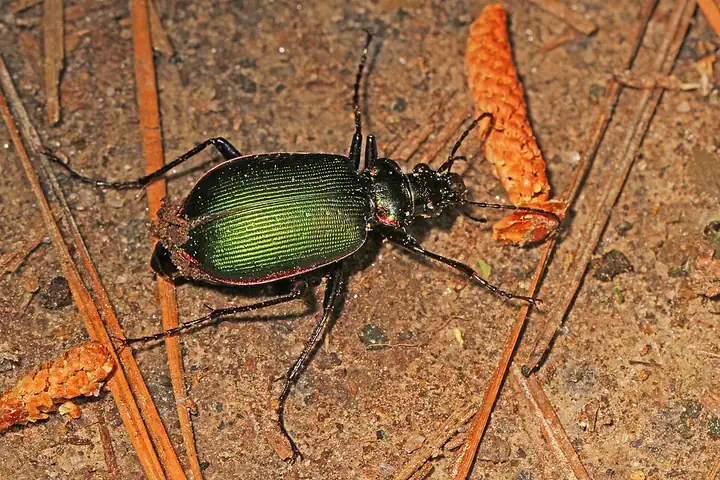
Ground beetles
Family Carabidae; thousands of North American species, such as caterpillar hunters (Calosoma), snail-eating Scaphinotus, and Pterostichus, Harpalus and Amara species
| Type | Insect |
|---|---|
| What it does | Predator |
| When | Spring through fall; larger adults can live two to four years. |
| How common it is by region | Very common here: Northeast, Southeast, South Central, Midwest, Great Plains, Mountain West, Southwest, Pacific Northwest, California |
About
Ground beetles are the shiny, usually black, fast-running beetles that dash away when you lift a board or a pot. They hunt at night on the soil and are one of the main reasons slugs, caterpillars and soil pests don't take over a garden.
This one is already on your side. Broad sprays kill it along with the pest, which is why the guide puts sprays last.
What it eats
Caterpillars, slugs, snails, wireworms, aphids, fly maggots and other small soil animals; some climb plants at night to find prey. Many also eat fallen weed seeds, which trims the weed seed bank a little.
Pests it goes after
Aphids, Brown garden snail, Colorado potato beetle, Slugs, Wireworms
Spotting it
How to find it early
Flattened, shiny beetles from under a quarter inch to over an inch long, mostly black or dark brown, a few metallic blue or green, with long legs and thread-like antennae. In the day you'll find them under mulch, stones, boards and compost, and at night some come to porch lights.
Its young
The larvae are long and slim, with a big head and curved, pincer-like jaws; they live in soil, mulch and leaf litter and hunt there too.
When
Spring through fall; larger adults can live two to four years.
Bringing more of them in
Give them shelter: straw or leaf mulch, perennial borders, hedgerows or a planted strip they can hide in when the beds are dug. Till as little as you can and avoid soil insecticides, which kill them directly.
Worth knowing
Some kinds give off a strong-smelling, irritating fluid when picked up, so handle them gently or not at all. A few kinds also nibble seeds, seedlings or ripe fruit.
How common it is by region
| Northeast | Very common here |
|---|---|
| Southeast | Very common here |
| South Central | Very common here |
| Midwest | Very common here |
| Great Plains | Very common here |
| Mountain West | Very common here |
| Southwest | Very common here |
| Pacific Northwest | Very common here |
| California | Very common here |
| Alaska | Common here |
| Hawaii | Common here |
Sources
Photo: Photo: Judy Gallagher / Wikimedia Commons, CC BY 2.0 (CC BY 2.0). Photo resized for the web.

Planting dates and advice are general guidance; check with your local Cooperative Extension office for your area.